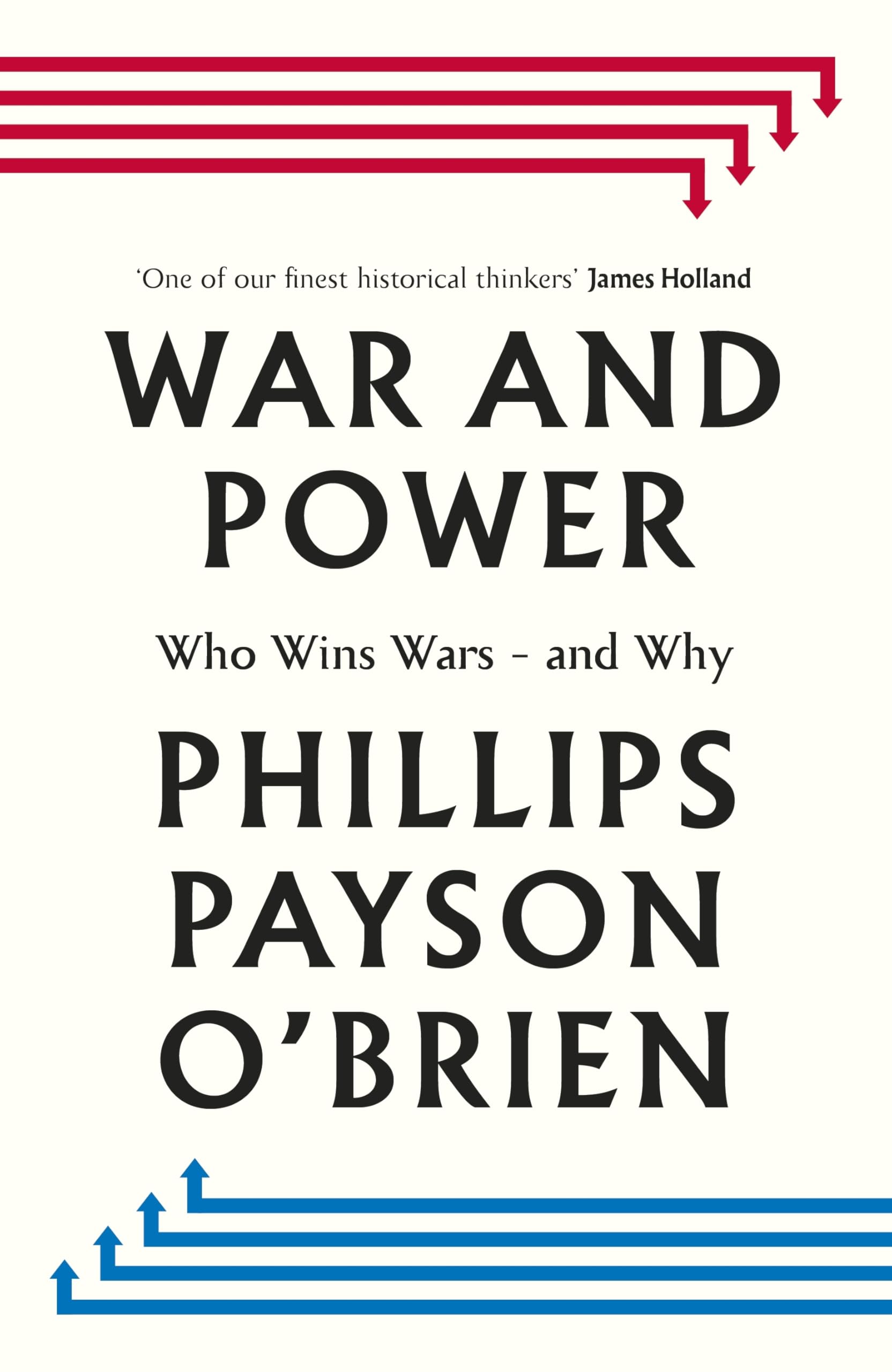
A collection of revealing facts and stories from (mostly) 20th century military history explaining how wars usually are being won. The author, a strategic studies professor, argue that the (currently) most popular theory of international relations - “realism” - do not account for the importance of durable alliances, morale and will to fight. He argues that the importance of great power status, individual battles are overrated. Economic production capacity and alliances lead to the Allies victory in WW2. The book is an unconcealed criticism of MAGA foreign policy which discard the importance of alliances.
For readers familiar with the international history of the world wars and the Cold war, the conclusions are hardly surprising. Retelling the buildup to the outbreak of WW1 seem to be standard in all Grand strategy books. If you need to quarrel with supporters of the “Mearsheimer school” of international relations, this book is book is an excellent reservoir of counter examples to this theory. Readers interested in military history will already be familiar to many of the stories in this book.
Highlighs
It is the German historian Leopold von Ranke who is said to have first coined the phrase in print, in 1833. To him a great power was one that could ‘maintain itself against all others, even when they are united’.
— location: 280 ^ref-49323
prophecy. It did not matter that there was no commonly accepted notion of a great power; as long as Russia was labelled one and Ukraine was not, that gave the former’s claims of interest the greater legitimacy. Basically, in the great power world, the great powers are subjects, and the lesser powers are objects with which the great powers can toy.
— location: 384 ^ref-39509
So, making four-engine bombers ended up being an operation of great complexity, and doing so cost far more than any other weapons programme of the war. Designing and building the B-29, for instance, cost a minimum of $3 billion and might have reached $3.7 billion. In comparison, the designing and building of the atom bombs under the Manhattan Project cost $2 billion.
— location: 883 ^ref-29288
By 1943 not only were they spending half of their economy to building aircraft (overwhelmingly fighters, to confront Allied bombers), but German expenditure on anti-air weapons and ammunition (once again, overwhelmingly directed at the British and American bombing campaign) was approximately equal to the amount spent building all German tanks and self-propelled guns.
— location: 896 ^ref-19126
Prime minister from 1937 to 1940 (and very influential as Chancellor of the Exchequer for the six years before that), he became a byword for a political leader who is willing to make enormous concessions to avoid war – or an ‘appeaser’. In some ways this charge is extreme, as Chamberlain was not as exceptional in avoiding war as Hitler was in pushing towards it.
— location: 1157 ^ref-57380
In 1944, for instance, in what is often seen as the peak year for US mobilization, there were fewer than 8 million soldiers in its army, out of a population of just under 140 million.
— location: 1946 ^ref-56467
But while the US had a small number of soldiers, relatively speaking, it possessed enormous stores of equipment. You can see this in almost every metric, but aircraft production is the most striking. Aircraft were the most prioritized pieces of military equipment in the war. Germany, for instance, devoted about 50 per cent of its war economy to the building and equipping of aircraft – far more than any other category. The amount the Germans devoted to all tanks and armoured fighting vehicles was somewhere between 5 and 10 per cent.
— location: 1950 ^ref-36761
The pipeline was heralded as a cheap and efficient way of bringing Russian natural gas to Europe, and had it ever been put into operation, it would have made Germany almost entirely dependent on Russia for its energy.31 The cost of Nord Stream 2 was $11 billion, with the Germans paying a large share.
— location: 2028 ^ref-42615
The strategic demises of Napoleon, Kaiser Wilhelm II, Adolf Hitler and later the USSR all came from the same basic element – their nations were overwhelmed by alliances of states that were collectively more powerful and determined. This reveals another one of the fundamental flaws in the great power view of international relations. The great power mindset divides up states between those who are supposedly so powerful they can do what they want, and those who are less powerful and must submit to their will.
— location: 2068 ^ref-28491
The Germans, with their ineffective dreadnought fleet, came to rely more and more on the submarine as the war went on. Almost all merchant vessels in the first years of World War I sailed singly on the high seas, without the protection of a convoy. This made them relatively easy prey – as long as the submarine could remain undetected. The British actually tried to ambush German submarines by placing hidden armaments (illegally) on some of their merchant ships, with the aim of blasting away at any hapless German submarine that surfaced nearby to undertake its legal obligations. By 1915, the Germans had had enough of this gentlemanly form of warfare, and Britain’s illegal attempts to circumvent it, and decided to allow their submarines to sink merchant ships without warning while remaining submerged. This kind of warfare, known as unrestricted submarine warfare, was both extremely effective and extremely contentious – and ended up having a huge impact on the course of the war.
— location: 2592 ^ref-26542
The German decision to restart unrestricted submarine warfare in early 1917 is one of the most catastrophic choices in strategic history. As mentioned earlier, the Germans had tried unrestricted submarine warfare around the British Isles in 1915. However, this ended up leading to a crisis with the US and by early 1916 they had pulled back under the threat of a breakdown in relations with America. At the end of 1916, however, there were calls to restart the campaign.
— location: 3182 ^ref-7040
The Spanish dictator Francisco Franco, only a few months later, ignored Hitler’s blandishments and refused to have Spain join the war on Germany’s behalf. Like Mussolini in 1939, he asked Hitler for so much support for the Spanish war effort that Hitler blanched. And from that point, Franco was able to stay out of the war. While Mussolini ended up being gunned down on a nondescript Italian street corner in 1945, Franco died in his bed thirty years later.
— location: 3221 ^ref-52567
Japan at this time had one of the most remarkable war leadership structures in modern history. The army and navy were basically self-governing entities, each of which had high representation in the Japanese government. Though the government also had a prime minister, the ability of that person to give orders to the army and navy was limited. For the government to take coordinated action, therefore, the army and navy had to be in agreement. Even then, once the decision was made to go to war, the military were to a large degree free to prosecute the war in whichever way each service wanted. The result was that, when it came to World War II, for much of the time the Japanese Army fought one war and the Japanese Navy another – with neither service able to do much to influence the other, or even, as it turned out, to find out basic information from the other. It ended up being a recipe for disaster. The Japanese Army, for instance, precipitated World War II in Asia by launching, without the knowledge of the navy, the invasion of China in 1937. From that point on Japan’s Kwantung Army made most of the decisions for itself about how and to what depth the war against China would be pursued. Eventually, somewhat to the dismay of the Japanese government, the army ended up involved with an invasion that covered thousands of miles of China, and one that stretched Japanese resources to the utmost. And if the army didn’t listen to the navy – or anyone else really – when it came to the prosecution of the war, the navy was little better. After the Japanese attack on Pearl Harbor had started the war with the United States, the navy was allowed a great deal of latitude to prosecute the war in the Pacific against the Americans.
— location: 3227 ^ref-49441
The Japanese fleet, led by Admiral Togo, was well drilled and ready for action. When the fleets met, the Japanese had a properly thought-out plan, as well as the ships and men to execute it. When the Russian fleet first emerged in the Tsushima Strait (which separates Japan from Korea), the Japanese fleet manoeuvred quickly to cross the Russian ‘T’ – which meant sailing its force across the top of the moving Russian column. With its entire line of ships thus facing the top of the Russian column, the Japanese were able to concentrate their firepower on the leading Russian vessels, while also making it impossible for the Russians to fire on them with all but a handful of their ships.19 The result was that the Russians lost all shape, and became sitting ducks for the efficient Japanese. When the battle was over, two-thirds of the Russian fleet had been destroyed, six ships had been seized, six fled to neutral ports and only four reached safety in Vladivostok. It was one of the most one-sided victories in modern naval history.
— location: 3300 ^ref-28109
By the end of their involvement, about 58,000 US soldiers had been killed. In exchange, about 1.1 million North Vietnamese and Viet Cong fighters were dead.30 And yet it was the US that eventually decided they’d had enough and withdrew.
— location: 3379 ^ref-58757
Even in August 1914, when it was said there was widespread German war enthusiasm (an idea that was reported more after the fact than during), there were signs that many Germans were more apprehensive than anything else.
— location: 3412 ^ref-54433
The administration assured the American people that the war was about to be won, but arguably had no strategy to make that happen. When the American people could no longer reconcile the difference between these two positions, they turned against the war. It began the process of politically forcing the US leadership to get out of the conflict. In the 1968 election, both the Republican nominee, Richard Nixon, and the Democratic one, Johnson’s VP Hubert Humphrey, ran calling for an end to direct military involvement in Vietnam. The victor, Nixon, would see to it that US forces were out of Vietnam by the end of his first term – and he would gain a significant amount of public support because of it.
— location: 3483 ^ref-34760
Yet by 2024 the Ukrainian government claimed to be manufacturing 4 million UAVs in a wide range of different configurations.
— location: 3502 ^ref-27697
the key thing about the V-2 as a weapons system was that it did not justify its enormous cost. It has been estimated that the V-2 programme was, in relative terms, as expensive for Germany as the Manhattan Project designing the atomic bomb was for the US. However, like the Me 262, it appeared too late in the war and in too few numbers to make a difference. First launched against Britain in September 1944, just over 1,000 hit the UK (many others were launched against Antwerp once it was liberated by Allied forces).23 And those that hit did no damage to British production, while thankfully killing only a relatively small number of British civilians – approximately 2,500.24 Tragically, far more people were killed building the V-2 in the slave labour factories set up for their construction.
— location: 3739 ^ref-44808
Because the Allies controlled the seas through the Royal Navy, the only way that the US could ever join the war was in combination with them. All US trade with Germany was stopped very early on in the war, whereas trade with the Allies boomed. Soon the trade accompanied loans, and the US built up a massive economic stake in an Allied victory.
— location: 3913 ^ref-16274
And yet in both cases the supposedly dominant power lost, at least partly because the far weaker power received enough military aid to draw out the war and fight effectively. Certainly at the end of the Cold War, when the balance was taken of the four-decades-long struggle, more Americans had died fighting the Vietnamese than had died fighting the USSR; and likewise more Soviet soldiers had died fighting the mujahideen than died fighting the Americans. The value of both of these smaller powers as allies to the larger was far more than, say, the value of Mussolini’s Italy to Hitler’s Germany.
— location: 4139 ^ref-30804
Over the next two decades, the US is estimated to have spent an eyewatering $2.3 trillion on the intervention.
— location: 4187 ^ref-5360
The assumption that the Biden administration had made (and those around Donald Trump had as well) was that Ukraine would be quickly conquered. Indeed, the administration thought so little of the Ukrainians’ willingness to fight for themselves that they engaged in a bout of self-pity. On the eve of the Russian invasion, the president bemoaned his own fate, saying: ‘Jesus Christ! Now I’ve got to deal with Russia swallowing Ukraine?’27 Sadly for the US and the democratic world, the Biden administration was never able to adjust its understanding of the value of Ukraine as an ally. It continued to view Russia as some great power that should not be defeated and Ukraine as a small power that needed modest support, but who could never be a true ally. Biden kept Ukraine from being given a clear path to NATO membership and also strictly limited the military aid given to the Ukrainian military. Crucially, Ukraine was given US aid to fight only a limited-range war, and was forbidden to attack Russian military targets in Russia (even those which were being used almost daily to attack civilian targets in Ukraine). The result was that the Biden administration transformed what could have been a Ukrainian victory into a long-term, bloody and grotesque attritional struggle that resembled World War I (with drones) more than anything else.
— location: 4203 ^ref-25124
- Author: Phillips Payson O’Brien
- ASIN: B0F2SDJ2NS
- ISBN: 0241744180
- Reference: https://amazon.com/dp/B0F2SDJ2NS
kindle-title: ‘War and Power Who Wins Wars — and Why’ kindle-author: Phillips Payson O’Brien kindle-asin: B0F2SDJ2NS kindle-lastAnnotatedDate: ‘2026-04-21’