Book review of Gorbachev: His Life and Times by William Taubman
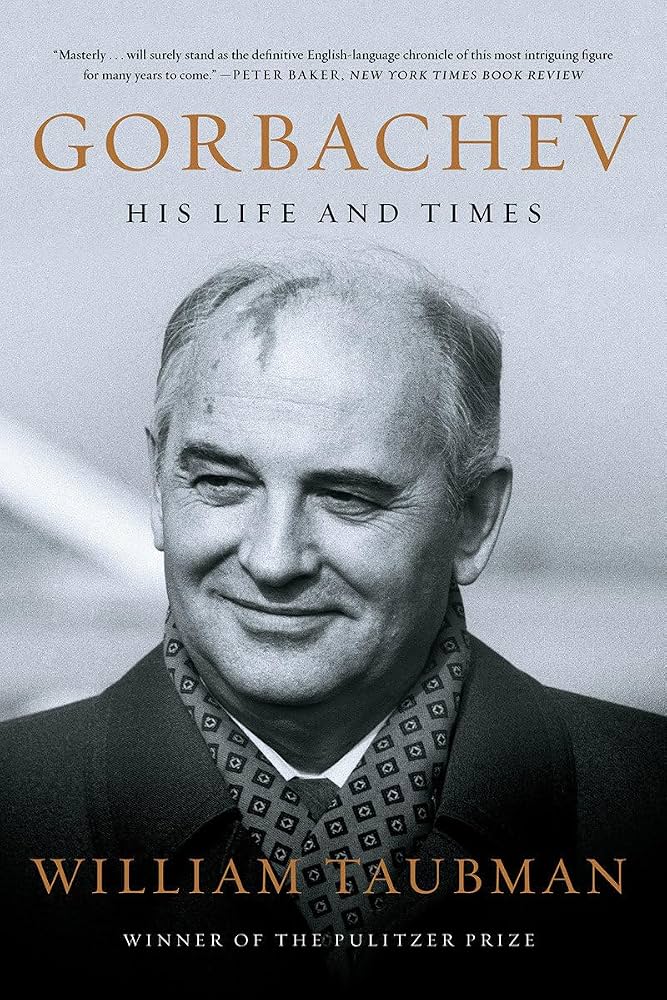 A well researched, well written and fairly conventional chronological biography of the life and work of Raisa og Michail Gorbachev, written five years before Gorbachev’s death. Emphasis on explaining his success as a foreign politician (from a peace and democracy maximising perspective), while being an utter failure in his domestic policy.
Being a nearly the few “true believers” left of Leninism landed him the job as party secretary in 1985, but was also the reason he was utterly idealistic and was unable to comprehend most people would do away with everything he truly believed in, whether it was Leninism, planned economy and the Soviet union. And the people would get rid of it, as well as his job as soon as they were allowed.
According to William Taubman, why was Gorbachev elevated to the top office of the Soviet union when secretly wanted to reform it?
— “Gorbachev made it to the top by seeming to be an ideal product of the Soviet system. Powerful figures like Andropov, Kulakov, Suslov, Kosygin, even Brezhnev (to the extent he was still compos mentis), aware of the cynicism and corruption all around them, were thrilled to discover an idealistic, energetic, educated young party leader who still sincerely believed in Communism. What Gorbachev concealed was that the Communism he believed in wasn’t the carcass of Stalinism over which they presided.”
Why did the breakup between Yeltsin and Gorbachev lead to the breakup of the Soviet union?
— “By now Gorbachev hated Yeltsin. Yeltsin had tried to steal Gorbachev’s banner by presenting himself as the real champion of change. Yeltsin dared to point out Gorbachev’s shortcomings: the failure to develop a clear strategy and explain things clearly, the tendency to talk too long and to promise too much. Yeltsin reminded Gorbachev of the crude colleagues in Stavropol he despised. Moreover, Gorbachev shared some of the very failings he condemned in Yeltsin. Arrogance, vanity, pride—to the extent he was aware of these shortcomings in himself, Gorbachev tried to contain them. So when Yeltsin flaunted them all, in what Gorbachev regarded as a wild, erratic attempt to damage the great cause of perestroika, Gorbachev’s anger may have been aimed at least partly at himself.”
Why was Gorbachev such an important leader?
— “…he was “the only politician in Russian history who, having full power in his hands, voluntarily opted to limit it and even risk losing it, in the name of principled moral values.”
Kindle highlights
The late Russian scholar Dmitry Furman framed Gorbachev’s uniqueness more broadly: he was “the only politician in Russian history who, having full power in his hands, voluntarily opted to limit it and even risk losing it, in the name of principled moral values.” ^ref-44346
- 413 location: 413
During the terrible famine of 1932–1933, two of Gorbachev’s uncles and one aunt perished. Stalin’s Great Terror of the 1930s swept up both of Gorbachev’s grandfathers: his mother’s father arrested in 1934, his other grandfather in 1937. ^ref-37924
- 488 location: 488
MGU was to the USSR what Harvard is to the United States—except that in the Soviet Union there was almost nothing else, no Yale, Princeton, or Stanford, no Ivy League, no equally distinguished state universities, no elite liberal arts colleges. ^ref-13309
- 048 location: 1048
The study of law in a country without the rule of law did not enjoy great intellectual prestige, but Gorbachev couldn’t know that. ^ref-62163
- 064 location: 1064
Behind the Kremlin curtain, while Stalin’s heirs debated what to say about their former master, Khrushchev was preparing to denounce him, a step that risked undermining the regime they had inherited. ^ref-38789
- 901 location: 1901
Kulakov would never forgive him. “The very best speech,” he continued, “is the one that goes ungiven.” Excellent advice! Gorbachev didn’t follow it often enough when he was Soviet leader. ^ref-37552
- 223 location: 2223
Sociology, she would later explain, had “ceased to exist as a science” in the 1930s because it was “dangerous” to the system Stalin was constructing. That system rejected the kind of “feedback” that sociological studies could provide. The system was “organically alien to it, just as it is alien to the system.” The ^ref-44045
- 293 location: 2293
Regional party chiefs were personally vetted by Kremlin leaders. Gorbachev’s record was scrutinized by Central Committee secretaries Ivan Kapitonov and Konstantin Chernenko, later Gorbachev’s predecessor as general secretary. He was interviewed by Kapitonov, Kulakov, and Politburo members Andrei Kirilenko and Mikhail Suslov; Suslov was variously known by Westerners as the party’s “gray cardinal” or “ideologist in chief.” In none of these awkward conversations, marked mostly by small talk, did anyone mention why Gorbachev was being interviewed. That remained for Brezhnev himself, when he received Gorbachev in his party office on Old Square, several blocks from the Kremlin. ^ref-42931
- 470 location: 2470
That sounds innocuous enough, but under the heading “contradictions,” a phrase beloved by Marxist theoreticians but applied very gingerly to the Soviet Union by Soviet ideologues, ^ref-9714
- 532 location: 2532
During his first few years as Stavropol party boss, Gorbachev attributed economic and other failures to “the inefficiency and incompetence of cadres, flaws in management structure or gaps in legislation,” but gradually he concluded that “the roots of inefficiency lay much deeper.” What “deeper” meant to Gorbachev during these years was the severe overcentralization of the economy, in which all key decisions were made at the top. As a result, he and other regional leaders had to make “endless trips to the capital,” where they had to cajole the big bosses and “endure abusive language and rudeness from officials.” “The supercentralized attempt to control every single detail of life in an immense state sapped the vital energies of society.”22 Much later, after he became Soviet leader, Gorbachev would dig deeper still, tracing the problems he saw in Stavropol to the very essence of Soviet state socialism, that is, to the Communist party’s monopoly of political and economic power. ^ref-16482
- 576 location: 2576
Not all their songs were forbidden; indeed some were recorded, and Vysotsky was a star actor at the Taganka Theater in Moscow. But many songs were available only on tapes passed from hand to hand by admirers who told the next in line not to reveal where they came from. ^ref-23599
- 799 location: 2799
Andropov developed what Arbatov and Soviet dissident historian Roy Medvedev called a “Hungarian complex,” namely, the fear that attempts to reform “from below” were fated to morph into mob rule ^ref-41921
- 872 location: 2872
In 1975, Andropov helped persuade Brezhnev to sign the Helsinki accords on security and cooperation in Europe, even though Basket Three required signatory states to pledge their support for human rights and political freedoms that were routinely denied in the USSR. “In 15 to 20 years we’ll be able to allow ourselves what the West allows itself now,” Andropov told diplomat Anatoly Kovalev, “freedom of opinion and information, diversity in society and in art. But only in 15 to 20 years, after we’re able to raise the population’s living standards.” ^ref-36972
- 892 location: 2892
FOREIGN TRAVEL, ESPECIALLY to capitalist countries, was ironically one of the greatest gifts Soviet Communism could bestow on its own faithful servants. Only the politically reliable were allowed to visit the West; ^ref-2263
- 957 location: 2957
he and Eduard Shevardnadze (then Georgian party boss, later Gorbachev’s foreign minister) were strolling along the Black Sea shore, when Shevardnadze suddenly remarked, “You know, everything is rotten.” Gorbachev agreed.7 But for the time being, Gorbachev played the Kremlin game: watching and waiting, listening and learning rather than speaking out, concealing his unorthodox views, cultivating bosses who could move him ahead, getting around those who stood in his way. In retrospect, it’s clear he was playing the game in order to change it. Ironically, though, he was better at old-style Kremlin infighting than at the new game of open, mass politics that he himself would later introduce. ^ref-60359
- 208 location: 3208
Brezhnev wasn’t too far gone to raise the possibility of his own retirement. But whenever he did so, his colleagues insisted he was indispensable. What they actually feared was that his departure would reduce their own power to govern in his name, while triggering a dangerous succession struggle. ^ref-58164
- 396 location: 3396
BETWEEN HIS 1978 ARRIVAL in Moscow and Brezhnev’s death on November 10, 1982, Gorbachev was a Kremlin backbencher while a gang of six ran the country: Brezhnev (who still had the last word when he was able to utter it), Suslov (an exceptional number two man, until his death on January 25, 1982, in that he didn’t aspire to be number one), Gromyko (Politburo member since 1973 as well as foreign minister since 1957), Andropov (promoted from the KGB to Central Committee secretary after Suslov’s death), Defense Minister Marshal Dmitry Ustinov and Chernenko. ^ref-59990
- 411 location: 3411
Brezhnev often muffed letters and sounds, for example, when the Russian word for “systematically” (sistematicheski) emerged from his mouth as “tits” (siskimasiski). ^ref-42216
- 138 location: 4138
Lenin, who was never a democrat in the way that Gorbachev proved to be. By now most historians, inside the former Soviet Union and out, blame Lenin for founding the totalitarian system that Stalin perfected and personally placing Stalin at its helm. ^ref-52211
- 177 location: 4177
But the Soviet economy wasn’t set up to produce abundance, partly because military spending (which equaled or exceeded U.S. levels, though the Soviet economy was one-quarter the size of its American counterpart) ^ref-10772
- 203 location: 4203
Gorbachev admitted that he consulted his wife. Once asked by NBC television newsman Tom Brokaw about what, he replied, “About everything.” But when this interview was telecast and published in the Soviet Union, Gorbachev’s answer was considered too sensitive to be transmitted by the Soviet media. ^ref-14939
- 336 location: 4336
To provide the population with something to buy other than alcohol, the chronically short supply of consumer goods would miraculously have to balloon by some 21 billion rubles’ worth. Otherwise, warned the State Planning Commission’s Lev Voronin, “we literally will have nothing to sell to people who have money to spend.” ^ref-18180
- 481 location: 4481
And he had very sharp things to say about the system he inherited. But his recipe for the future still boiled down to “acceleration. ^ref-19978
- 560 location: 4560
Another new agency, the State Acceptance Commission, applied quality-control methods that worked in military procurement to high-priority civilian output: output had to be approved by the commission before it could be sold and shipped. But the main result was to create a new layer of inspectors who were bribed or otherwise convinced that the same old low-quality output passed muster. All we succeeded in doing, Gorbachev recalled, was to “move the lump.” ^ref-26087
- 570 location: 4570
In theory, the Bolsheviks had always welcomed “criticism and self-criticism,” while punishing those who practiced the wrong kind. ^ref-15499
- 751 location: 4751
EVER SINCE LENIN, the Bolsheviks had viewed world politics as class struggle projected onto the global stage. Soviet Russia represented the exploited of the earth. The capitalist, imperialist powers were Moscow’s sworn enemies. Stalin saw the world as divided into two camps with conflict between them inevitable and enduring peace impossible. In Stalin’s time, the imperialist camp seemed more powerful, but the Soviet camp had important advantages. It could play on “contradictions” among imperialist powers, attempting to divide if not conquer them. It could urge on the working class in capitalist countries, if not to seize power, then to resist anti-Soviet aggression by their rulers.45 After Stalin’s death, his dog-eat-dog view of the world underwent important, but limited, modifications. Khrushchev transformed “peaceful coexistence” from a short-term tactic into a long-run strategy. ^ref-62374
- 066 location: 5066
In fact, some of the most ferocious fighting of the war took place during Gorbachev’s first years in office, and the number of Soviet troops, which had risen from 100,000 to 120,000 under Chernenko, remained at that level through the first half of 1986. ^ref-12073
- 277 location: 5277
Reagan’s thinking about the USSR was genuinely inconsistent. He knew of “no Soviet leader since the revolution” who was not determined to promote “world revolution and a one-world Socialist or Communist State.” They had spoken, he contended, “as plainly as Hitler did in Mein Kampf.” Yet the same Reagan had “a gut feeling” that if he could just talk to Chernenko “man to man,” he might “convince him there would be a material benefit to the Soviets if they’d join the family of nations.” Reagan considered the Soviets “paranoid about being attacked,” but thought the cure for that could be “a meeting to see if we can’t make them understand we have no designs on them but think they have designs on us. ^ref-58446
- 329 location: 5329
And so 1986 came to an end. Gorbachev was revolutionizing Soviet thinking about the world, but not changing the world itself. He favored a new relationship with Eastern Europe, but had barely begun to construct one. He wanted to end the Afghan war, but it was still on. He couldn’t change his country unless he could drastically lower its defense burden, but the United States wouldn’t cooperate. ^ref-3585
- 883 location: 5883
Nikolai Petrakov, Gorbachev’s future economic adviser, later remarked, “We do have competition—but it’s of consumers for goods. Absurd! Producers should compete with each other and run after consumers, not the other way round.” ^ref-18619
- 985 location: 5985
Initially, the task fell to literary works focused on historical blank spots: collectivization (Boris Mozhaev’s Peasant Men and Women), the purges (Rybakov’s Children of the Arbat), wartime deportation of ethnic minority nations (Anatoly Pristavkin’s A Little Cloud Spent the Night), the Stalinist bureaucracy (Aleksandr Bek’s A New Assignment), the destruction of Soviet genetics (Vladimir Dudintsev’s White Garments and Daniil Granin’s Zubr), ^ref-35677
- 105 location: 6105
By now Gorbachev hated Yeltsin. Yeltsin had tried to steal Gorbachev’s banner by presenting himself as the real champion of change. Yeltsin dared to point out Gorbachev’s shortcomings: the failure to develop a clear strategy and explain things clearly, the tendency to talk too long and to promise too much. Yeltsin reminded Gorbachev of the crude colleagues in Stavropol he despised. Moreover, Gorbachev shared some of the very failings he condemned in Yeltsin. Arrogance, vanity, pride—to the extent he was aware of these shortcomings in himself, Gorbachev tried to contain them. So when Yeltsin flaunted them all, in what Gorbachev regarded as a wild, erratic attempt to damage the great cause of perestroika, Gorbachev’s anger may have been aimed at least partly at himself. ^ref-53844
- 452 location: 6452
Marxist-Leninist philosophy was neither Marxist nor Leninist nor philosophy. ^ref-17610
- 503 location: 6503
It was Gorbachev himself, actually, who ignited the first ethnic explosion, in late 1986 in Kazakhstan. The republic’s then leader, Dinmukhamed Kunayev, was as corrupt as they came. Brezhnev had tolerated him, but Gorbachev wasn’t about to. Kazakhs had plenty of grievances: the use of republic territory for Soviet nuclear testing, the steady shrinkage of the Aral Sea (once one of the four largest lakes in the world) excessively diverted for irrigation, the dominance of Russians in the developed north of the republic. But instead of addressing these problems, Gorbachev decided to replace Kunayev, not with another Kazakh, but with a Russian, Gennady Kolbin. ^ref-50538
- 043 location: 7043
If the Tatars were allowed to go back to the Crimea, then other exiled groups would demand return from Central Asia banishment—Meskhetian Turks from Uzbekistan to Georgia, Volga Germans to the Volga, and so on. Fortunately for Gorbachev, the Tatar demonstrators settled for vague promises and dispersed. ^ref-21632
- 063 location: 7063
He denied that greater democracy would make things more difficult. On the contrary, he was convinced that nationalist excesses arose from the lack of democracy. ^ref-46175
- 117 location: 7117
It was as if, Yakovlev recalled, he were “attached to verbosity” as a way “to escape from concrete problems into a dense, almost impenetrable thicket of words.” ^ref-37140
- 193 location: 7193
When Western journalists asked Gerasimov to explain the difference between 1968 and 1987, he answered pointedly: “Nineteen years”—saying, in effect, there was no difference at all. ^ref-59680
- 285 location: 7285
Gorbachev’s January 1987 speech supporting democratization in the USSR was banned in East Germany, with the “absurd” result, says Medvedev, that East Germans had to learn about it from West German media. ^ref-2178
- 379 location: 7379
Solovyov and Ligachev went so far as to imply that Gorbachev had “set up” hard-line party officials to be defeated. And in a sense they were right. He wanted to subject them to the popular will, and he rejoiced when they were rejected. “It serves them right for treating the people as they do. ^ref-5147
- 270 location: 8270
All Congress sessions were televised live from gavel to gavel with most of the country watching, as people skipped work to do so and debated in their homes what they saw and heard on the screen. There had been some opposition to this in the leadership, and initially newspaper TV listings included only opening and closing ceremonies, but in the end Gorbachev insisted on transmitting in full what the country had never seen before—the political decision-making process. ^ref-37377
- 424 location: 8424
The seeming contradiction between Gorbachev’s uninspiring background and his enormous achievements puzzled Sakharov, as it did so many. ^ref-44280
- 498 location: 8498
This was the successful culmination at the highest level of all his abortive attempts, beginning in godforsaken villages around Stavropol, to solve social problems through discussion rather than fiat. Gorbachev was trying to develop a true “parliamentary culture” in a country that never had one, Shakhnazarov recalled, so he stayed on after sessions ended, meeting with deputies, hearing them out, seeking to understand them and their concerns. The fact that the country’s chief executive was doubling as the speaker of its parliament, taking valuable time off from running the country and its foreign policy to referee novice legislators’ endless, unruly debates, was in a sense madness. Some of his supporters warned him that by doing so he was lowering his prestige and weakening his authority. But who else could tutor the deputies and the millions watching on television in the culture of parliamentary governance? ^ref-29056
- 547 location: 8547
On August 23, the fiftieth anniversary of the 1939 Nazi-Soviet agreement to divide the Baltics between them, some two million Estonians, Latvians, and Lithuanians, about 40 percent of the total Baltic population, held hands in an unbroken human chain linking the capitals of Tallinn, Riga, and Vilnius. ^ref-63345
- 603 location: 8603
“Even in the most dramatic moments,” Chernyaev recalled, “even in the period of German reunification, [foreign policy] took up only five or six percent of the considerations of Gorbachev and the Politburo, of their time and their nerves.” ^ref-14189
- 858 location: 8858
Another factor was Gorbachev’s vision of Europe’s future. He had long hoped reform Communists like him would eventually come to power in Eastern Europe and adopt their own versions of perestroika. So he was delighted, rather than dismayed, to see Honecker, Husák, Zhivkov, and Ceaus¸escu go. He didn’t despair when non-Communists took over, as long as they kept their countries in the Warsaw Pact and the Council for Mutual Economic Assistance (Comecon). ^ref-27806
- 867 location: 8867
Gorbachev didn’t lay out a blueprint, but talked about ruling out the use of force or threat of force, creating a “vast economic space from the Atlantic to the Urals,” protecting the environment and respecting human rights. ^ref-2871
- 880 location: 8880
The list did not include helping Gorbachev transform his country and close out the cold war. Because the overriding purpose of American foreign policy, as understood by the “realists” around Bush, “should not be how can we help perestroika or Gorbachev, but how can we promote the interests of the United States.” The words are those of Ambassador Jack Matlock Jr. in the third of three cables he sent from Moscow in February 1989. Actually, Matlock did want to help Gorbachev, but he couched his advice carefully so as to preserve his credibility; his first cable’s main message was that what Gorbachev was doing was itself in the American national interest: “In sum, the Soviet Union has, in effect, declared the bankruptcy of its system, and just as with a corporation which has sought the protection of Chapter XI, there is no turning back.” ^ref-31846
- 969 location: 8969
Indeed, the “Brezhnev Doctrine”—that Moscow would intervene by force, if necessary, to maintain Communist control of Eastern Europe—was officially abrogated at the Warsaw Pact summit in Bucharest in July 1989. According to the meeting’s concluding document, relations among member countries were to be characterized by “equality, independence and the right of each country to arrive at its own political position, strategy and tactics without interference from an outside party.” ^ref-7793
- 157 location: 9157
On March 3, Miklós Németh, another reformer serving as Hungary’s prime minister, told Gorbachev that his government had decided to open the border with Austria since it now serves “only to catch citizens from Romania and the GDR who are trying to escape illegally to the West through Hungary.” But to this unprecedented breach in the Iron Curtain, which kept widening until the Berlin Wall itself fell, Gorbachev replied only, “We have a strict regime on our borders, but we are also becoming more open.”68 That same month the Hungarian Central Committee endorsed the principle of free elections and a multiparty system. And when Grósz repeatedly asked Gorbachev to back his resistance to such changes, Gorbachev “consistently and knowingly refused to do so.” ^ref-36558
- 199 location: 9199
DURING SOVIET TIMES, the English terms “Russia” and “the Soviet Union” were often used interchangeably, but mistakenly so. Russia, officially known as the Russian Soviet Federative Socialist Republic (RSFSR), was by far the biggest of the USSR’s fifteen republics, accounting for half of the union’s population, two-thirds of its economy, and three-quarters of its territory. But the other fourteen were, at least formally, Russia’s equals. ^ref-15887
- 526 location: 9526
While Gorbachev’s country was coming apart in 1990, he was trying to bring the world together and to keep himself together in the process. ^ref-51412
- 267 location: 10267
He says he was pursuing his vision of a post–cold war world in which Germany and a transformed USSR could become genuine allies, as would the Soviet Union and the United States. All this is true, but that doesn’t exhaust the question of his motivation. He had indeed become psychologically dependent on being lionized abroad. Just as important, his intellectual independence was on display in his ever-warmer relationships with Western leaders. Having broken decisively with Soviet orthodoxy, he had come to think like a Westerner (of the social democratic persuasion) himself. ^ref-43357
- 289 location: 10289
on January 25. At the meeting, he announced two key decisions—to accept German unification (instructing Marshal Akhromeyev to start preparing to withdraw Soviet troops from East Germany) while vigorously opposing a united Germany’s inclusion in NATO. But how was he to prevent that? There were still nearly 350,000 Soviet troops in East Germany, but using them or threatening to do so could mean war or renewed cold war. The alternative was hard bargaining from a position of weakness, but what could that possibly achieve? ^ref-14107
- 313 location: 10313
If full German NATO membership was out, what about the seemingly plausible alternatives (limited, French-style membership, or Soviet troops remain in Germany) that Western leaders feared and Soviet critics preferred? Instead, Gorbachev floated pipe dreams: united Germany in the Warsaw Pact, or in both NATO and the pact at the same time (two anchors are better than one, he contended), or the Soviet Union itself in NATO. ^ref-50891
- 429 location: 10429
When Baker heard that the Iraqi invasion was imminent, Shevardnadze checked with his own intelligence sources. “It would be completely irrational for Saddam Hussein to do this,” he told Baker. “It’s not going to happen. Don’t worry about it.” So when Baker confirmed that the invasion had begun, Shevardnadze, he recalled, “was thunderstruck, embarrassed for being misled by his own intelligence services and enraged by the lunacy of the deed itself.” ^ref-30442
- 740 location: 10740
Gorbachev recalled having “mixed feelings” about the prize. He was “flattered, of course,” to follow in the footsteps of Albert Schweitzer, Willy Brandt, and Andrei Sakharov (!), but to many Russians, who had regarded Nobel awards to Boris Pasternak and Aleksandr Solzhenitsyn as “anti-Soviet provocations,” this appeared like another one. 114 But he was mesmerized by the contrast between the world’s admiration for his accomplishments, and the scorn they evoked at home. ^ref-28365
- 854 location: 10854
Chernyaev found him poring over excerpts from letters and telegrams condemning him and his prize. Gorbachev read one of them aloud: “Mister [!] General Secretary: Congratulations on receiving the imperialists’ prize for ruining the USSR, selling out Eastern Europe, destroying the Red Army, handing over all our resources to the United States and the mass media to the Zionists.” And another: “Mister Nobel Prize winner: Thank you for impoverishing the whole country, for earning a prize from world imperialism and Zionism, for betraying Lenin and October, for destroying Marxism-Leninism.” Chernyaev asked Gorbachev why KGB chief Kriuchkov “collected all these and put them on his desk,” while regularly supplying him with polls showing that 90 percent of the population disapproved of the prize. “Do you think I haven’t thought about this,” Gorbachev replied, continuing to stare at his hate mail as if riveted to it. ^ref-43322
- 857 location: 10857
Yeltsin became even more powerful on June 12, when he was elected president of Russia with 59 percent of the vote—just the sort of popular mandate that Gorbachev, chosen Soviet president by the Congress of People’s Deputies, lacked. ^ref-24175
- 010 location: 11010
Thatcher urged anyone who would listen to compare the destruction of Nazism and the fall of Communism. The former cost the world tens of millions of lives; the Soviet people accomplished the latter themselves, and almost bloodlessly. So it would be a terrible mistake not to assist them. ^ref-57235
- 291 location: 11291
If Gorbachev’s absence at the early morning rally on August 22 (for which “I’ve been criticized for twenty years,” he noted in 2011) was the result of love for his wife,2 his remarks at a press conference later that day were an unforced error. He did not yet realize how fully party leaders had compromised themselves by supporting the coup. ^ref-14065
- 689 location: 11689
But privately he nursed his loathing for Yeltsin, growling to journalist Dmitry Muratov, “When they hang me, make sure that they don’t hang Yeltsin from the same birch tree.” ^ref-28017
- 315 location: 12315
The election wasn’t entirely rigged, but it certainly was corrupted by the all-out support Yeltsin got from rich oligarchs. In return for helping to save their property as well as their country from a return to Communist rule, they got even more property—“shares” (in mammoth, undervalued state enterprises) in return for massive “loans” to Yeltsin’s campaign. ^ref-52303
- 464 location: 12464
The truth is that Russia under Vladimir Putin largely abandoned Gorbachev’s path at home and abroad and returned to its traditional, authoritarian, anti-Western norm. But that only underlines how exceptional Gorbachev was as a Russian ruler and a world statesman. ^ref-55802
- 853 location: 12853
Gorbachev made it to the top by seeming to be an ideal product of the Soviet system. Powerful figures like Andropov, Kulakov, Suslov, Kosygin, even Brezhnev (to the extent he was still compos mentis), aware of the cynicism and corruption all around them, were thrilled to discover an idealistic, energetic, educated young party leader who still sincerely believed in Communism. What Gorbachev concealed was that the Communism he believed in wasn’t the carcass of Stalinism over which they presided. ^ref-23974
- 879 location: 12879
His training and experience in the party apparatus prepared him to accomplish this feat—but Boris Yeltsin, whom Gorbachev regarded as inferior, as a loose cannon, turned out to be better at the new, populist political game. ^ref-6146
- 911 location: 12911
The Soviet Union fell apart when Gorbachev weakened the state in an attempt to strengthen the individual. Putin strengthened the Russian state by curtailing individual freedoms. The burgeoning Russian middle class, estimated at 20 percent of the population, has Gorbachev to thank for opening the door to a better life—even if its members have been slow to recognize him as their benefactor. Too many Russians compensated for the sense of worthlessness brought on by the loss of empire with conspicuous consumption and glorification of the state. Will they or their children and grandchildren still feel the same about Gorbachev fifty years from now? Or will they come to appreciate him? Despite his flaws and his failure to achieve all his noble aims, he was a tragic hero who deserves our understanding and admiration. ^ref-12217
- 953 location: 12953
Metadata
- Author: [[William Taubman]] Gorbachev
- ISBN 0393647013