Bokomtale Revolutionary ideas av Jonathan I. Israel
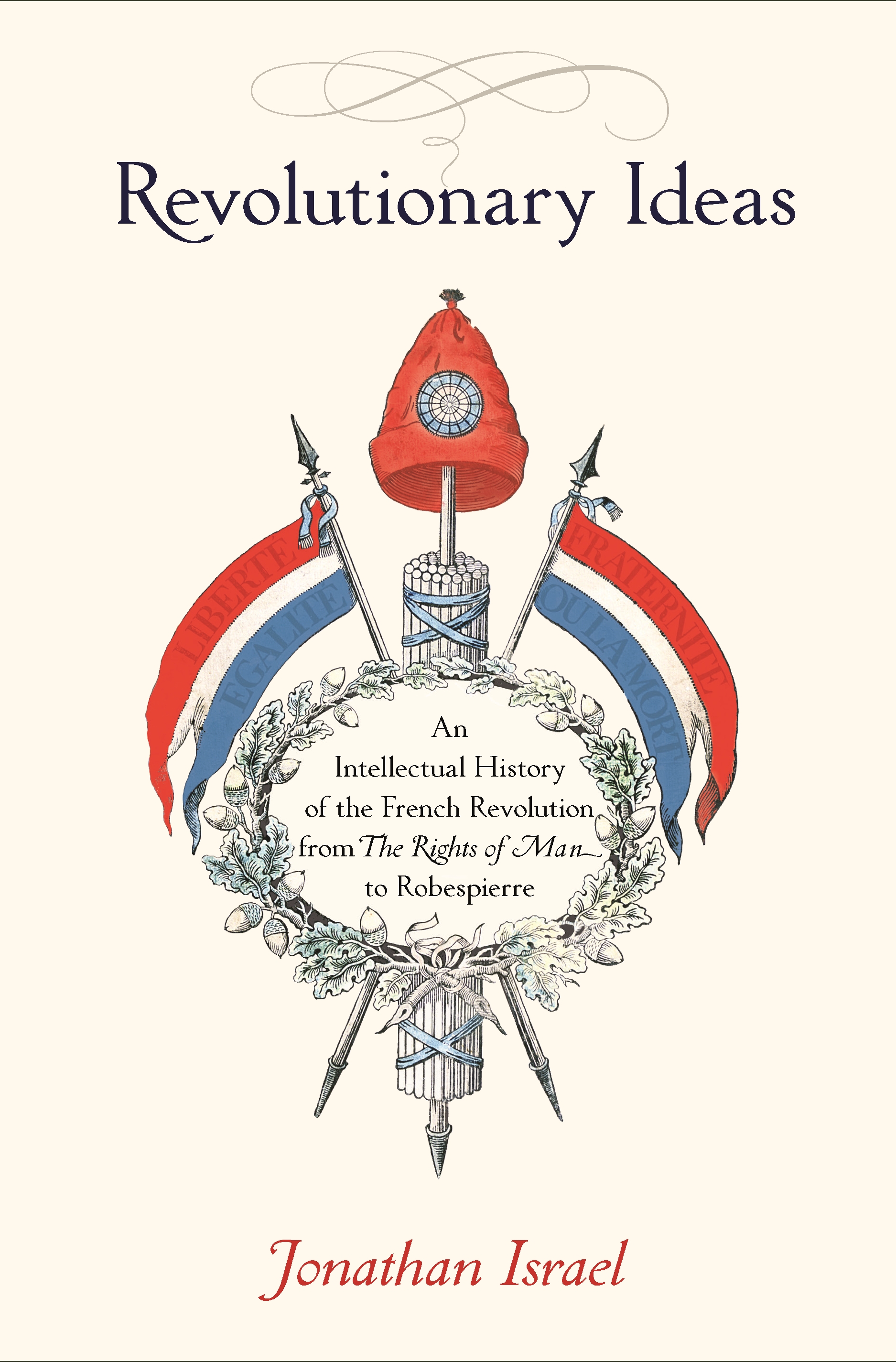
Revolutionary Ideas: An Intellectual History of the French Revolution from The Rights of Man to Robespierre
A detailed political history of the French revolution of 1789-99 as seen from the main protagonists at the national (i.e. Paris) level. Most chapters as well as the main story (800 pages) are in strict chronological order. The author, Jonathan Israel, doesn’t step outside the chronology by discussing topics interesting to scholars, but distraction to most readers e.g. what later historians have thought about the actors and actions. This makes the narrative feel like a constant flow of events, dilemmas, writings and intrigues ending abruptly with Napoleon’s coup in 1799.
Jonathan Israel is mostly concerned with the ideology and the political ideas of the most influential politicians and activists. He takes the writings, decisions and speeches at face value. He doesn’t assume that the ideology of the politicians are just power struggles masquerading as something else, like many generations of marxist inspired historians have always tended to do. As a political history, he is also not devoting much space for economic or military issues, except when these are unavoidable explanations for the decisions.
This feels both like a very modern and a very traditional history: It’s traditional by being focused on the ideas and decisions of the dozens people who tried to run (or ruin) the country. There’s no abstract abstruse talk of “social structures” or “classes”. Just men (apart from a few women) trying to influence day-to-day politics. It’s modern the way that it discard most interpretations of the French revolution preferred by marxists, social historians and new cultural historians. As Jonathan Israel notes in the introduction, the first half century after the revolution, the most favoured explanations of the revolution, both for its supporters and enemies, was that the ideas of enlightenment philosophers had tremendous importance in shaping the decisions. The emphasis on enlightenment philosophy fell out of fashion a century ago when marxists tried to force an orthodox class struggle scheme upon the history. So Jonathan Israel’s project seems to be the revival of the view that enlightenment philosophy was the main ingredient for the revolution.
Highlights
The universal principle of equality embraced in competing ways by all ruling factions between 1789 and 1799 was only finally discarded as the basis of citizenship and men’s rights with the new Constitution of 1799. This also discarded the Declaration of the Rights of Man, which in successive formulations had been fundamental to the Revolution throughout the momentous years from 1789 to 1799. Linked to this, black slavery, abolished by the Revolution in principle in 1794, was reintroduced by Napoleon in 1802.
— location:: 379 ^ref-3250
Easter 1802 Napoleon, as First Consul, formally ended the rift between France and the papacy by restoring the old episcopate and recognizing its power to appoint and control the lower clergy and exercise an unhindered spiritual authority over French Catholics and much of primary education.
— location:: 396 ^ref-26544
Between 1788 and 1820, the most common explanation of the French Revolution both in France and outside was, overwhelmingly, that it originated in “philosophy.
— location:: 404 ^ref-50657
Only about ten members out of the twelve hundred Estates-General deputies of 1789 could be described, like Mirabeau and Sieyès, as philosophes in the Enlightenment sense.
— location:: 429 ^ref-29787
Rousseau was the surpassing hero simultaneously of the Left and Right, a status no other ideologue ever achieved.
— location:: 553 ^ref-16752
In fact, the French would eradicate all hereditary nobility, venality of office, purchasing of noble titles for money, hereditary privilege, monopolies, arbitrary arrests, seigneurial jurisdiction, and illicit decrees. There would be no more Richelieus or Catherine de Medicis. The revolutionaries would establish liberty of commerce, liberty of conscience, liberty to write, liberty of expression. The Revolution would extinguish the parlements with their decrees, prohibitions, and lording it over the public. Once the Revolution gathered momentum, the parlementaire elite of France would perish, its influence and very name eradicated. France’s laws would henceforth be identical for everyone and the system of police spies and secret reports abolished.
— location:: 652 ^ref-38185
This interruption, especially the ten-month Terror (September 1793–July 1794), followed a prolonged power struggle. It produced a complete reordering of the Revolution’s basic values, in fact, the undoing of the Revolution. During these months, democracy, freedom of thought and expression, and the Rights of Man were jettisoned, freedom of the press aborted, individual liberty annulled, and terror exalted. But this catastrophic upset and trampling of human rights proved relatively brief and was then largely reversed again between 1795 and 1799.
— location:: 709 ^ref-5162
The new electoral system was introduced by the Crown itself when the Assembly of Notables reconvened in November 1788, in preparation for the elections for the Estates-General. The Crown proposed “doubling” the Third Estate’s representation and making each delegate the representative of an equivalent number of voters, hoping thereby to counterbalance the formerly overweening influence of the privileged and play off the Third against the nobility and clergy. But ministers had no wish to end separate voting by orders or to weaken privilege as such. They desired France to remain a society of orders politically and socially, with nobility and clergy able to overrule the Third.
— location:: 931 ^ref-27209
The Third’s deputies, historians often note, included no peasants, artisans, or laborers. But while peasantry and workingmen were indeed missing, it is equally striking that the Third, as constituted at Versailles in 1789, included practically no businessmen, bankers, entrepreneurs, or other members of major occupation groups characteristic of “bourgeois” upper-middle-class life either.
— location:: 959 ^ref-51668
Thierry maintained that successful Jewish emancipation and integration required an end to separate Jewish education based on religious authority. It required the state to introduce a secular, universal education under which Christian and Jewish children, mingling together, would jointly overcome obstacles created by the prejudices of centuries and equally imbibe enlightenment, morality, and civic values.
— location:: 1076 ^ref-60618
Experience soon revealed the drawbacks of full freedom of expression. It was highly dangerous, concluded some, to permit unlimited freedom. For this enabled ill-wishers to continually denounce the best, most knowledgeable, and virtuous as “scoundrels” and “traitors” who conspired with aristocratisme and monarchism. Unrestricted press freedom, lamented Desmoulins (who later with Danton, in 1793–94, tried to curb the Terror),86 called into existence a new species of political deceiver, le calomniateur despot, who systematically defamed rivals, forging a new kind of tyranny—le despotisme populacier—built on organized ignorance.
— location:: 1240 ^ref-47996
Then, contrary to all precedent and quite illegally, on 17 June the resulting enlarged Third proclaimed itself the “National Assembly,”
— location:: 1295 ^ref-17719
Three crucial sets of decrees dominated developments during the late summer of 1789: the abolition of feudal privileges of 4 August, the 26 August Declaration of Rights, and curtailment of the royal veto in September.
— location:: 1658 ^ref-47361
The parlements, the country’s chief repositories of legal expertise, were abhorred by all democratic revolutionary leaders due to their prominent role in the royal censorship and long campaign since the 1750s against the Encyclopédie and la philosophie, and hence purposely excluded from the revolutionary process altogether. That a small steering group of the Assembly could prod the rest into accepting that neither parlements nor any past or existing body, institution, charter, law, or precedent possessed any validity was something unparalleled in history and left foreign envoys aghast. Bad laws had corrupted society, affirmed Sieyès, among the “most resolutely philosophical of the major political actors of the French Revolution,” and continually conspired “contre la multitude.”2 Morals and the laws were all wrongly constituted, concurred Mirabeau, Roederer, and the pro-Revolution press. Yet it was one thing for Sieyès, Mirabeau, Brissot, Pétion, or Volney to pronounce every privilege by definition an affront to the rights of the “non-privilégiés” composing the majority, but quite another for the Assembly to agree that liquidating all privileges is required by reason and must ensue without delay.
— location:: 1661 ^ref-51561
Among the privileges abolished outright were favored access to military, diplomatic and civil posts, hunting “rights,” and special status before the law. For the first time in recorded history, all citizens, without distinction of birth, became eligible for all posts, positions, and dignities. The entire system of status, exemptions, and special fiscal privileges, including ecclesiastical immunities, ended.
— location:: 1685 ^ref-15063
Rather, late seventeenth- and early eighteenth-century natural right theories, indeed the whole corpus of natural law, was scorned by them because natural lawyers from Grotius down to Barbeyrac understood natural law to derive from the divine will and divine Providence and thus pronounced monarchy, aristocracy, and slavery all “natural” components of society.
— location:: 1777 ^ref-52697
Finalized on 26 August, the Rights of Man and the Citizen envisaged society’s renewal on a completely fresh basis, not one supposedly inherent in the nation’s legal past (as with the American Declaration).53 Where the American Declaration declares natural rights inherent in British constitutional liberties, the French Declaration invokes rights enshrined in laws yet to be made.
— location:: 1886 ^ref-20467
In 1789–90, the Revolution’s democratic republican publicists judged legislation good or bad not on the basis of precedent, experience, interest, or religion but according to whether it was, as Carra liked to say, “vraiment philosophique.”
— location:: 1997 ^ref-13571
The Revolution was threatened by challenges both within and without. The greatest challenge facing Mirabeau and Sieyès was that of how to organize political representation. Hostile to Montesquieu’s relativism and suspicious of Rousseau, both “fathers of the constitution” were likewise incisive, long-standing critics of the British and American constitutions. They rejected division of powers, together with all notion of balancing the monarch or quasi-monarch (the American president) against the nobility and Commons. There exists just one volonté générale, they contended, and this requires a single legislature controlling a subordinate executive and dependent judiciary. If the legislature truly represents the sovereign, it must remain in permanent session, supervising the state finances and, broadly, all policy, controlling every branch of government.
— location:: 2360 ^ref-535
In fact, less than 10 percent of France’s nobility, modern research shows, had become émigrés by 1791.
— location:: 2464 ^ref-56419
At this stage of the Revolution, Robespierre was also a leading advocate of unlimited freedom of the press, stressing especially its value as a safeguard against corruption.
— location:: 3325 ^ref-43918
Inevitably, much of the ensuing struggle revolved around conflicting claims as to who were the Revolution’s inspirers and what was their authentic message.
— location:: 3360 ^ref-34116
the still incomplete church of Sainte-Geneviève, among the capital’s largest buildings, now renamed the Panthéon, would be converted into a magnificent mausoleum to receive the remains of the Revolution’s principal authors and heroes and those earlier “great men” who laid the Revolution’s foundations, in particular Descartes, Voltaire, and Rousseau.29 The Enlightenment was invariably viewed by everyone, right, left, and center, as the Revolution’s chief foundation.
— location:: 3363 ^ref-22220
In Brissot’s estimation, the Assembly’s best delegates were simply the best educated—mostly practitioners of medicine and law. Artisans, he agreed, loved liberty and sought to defend it but were unreliable because they lacked literacy, enlightenment, and independence of judgment. Despite being cosmopolitan in outlook and sometimes useful, big merchants should, however, be regarded with greater suspicion since they care only for their own interest and generally operate to society’s detriment.
— location:: 3488 ^ref-294
The country was shaken to its foundations by the news of the king’s attempt, on 21 June 1791, to flee his realm. Until June, Louis XVI, characteristically, remained in two minds: loathing the Revolution privately while resisting pleas from advisors, family, and supporters to flee abroad and lead an international counterrevolution backed by the papacy, to defeat the Revolution and extinguish its principles.
— location:: 3644 ^ref-50569
The king’s attempt to flee transformed the entire French political situation by bringing the “moderate” Revolution’s and the Constitution’s underlying illogicality and incoherence fully to the surface.
— location:: 3665 ^ref-19430
Prior to the flight to Varennes, Marat’s paper made no move to denigrate the king or monarchy as such, and (unlike Jumel) Hébert did not do so before April 1791. But these papers were less concerned with concepts like monarchism, republicanism, or democracy than building popular paranoia for mass collective action. Continually appealing to the least educated, Marat’s and Hébert’s creed was a polarizing populist chauvinism, a kind of protofascism, in Marat’s case continually calling for a dictatorship of the most uncompromising kind to rescue “the people.” What was needed, urged Marat, was a personal dictatorship, preferably Robespierre’s. In Robespierre, Marat recognized a towering leader as steely, unbending, and uncompromisingly Manichaean as he himself, someone who divided all mankind into the good and the evil, oppressed and oppressors, ceaselessly attacking corruption in high places and eulogizing “the people.”
— location:: 3684 ^ref-46667
The Jacobins, the only political club with mass support that also provided a regular platform for Assembly deputies, remained utterly divided. In fact, they split four ways. The dominant faction backed Barnave, the Lameths, and Lafayette, intent on upholding monarchy and retaining Louis XVI; a second group spoke of deposing Louis but retaining the monarchy, substituting for the present incumbent the self-proclaimed constitutional monarchist Louis-Philippe d’Orléans. A third group, the populist faction, nervous lest the Jacobins, Robespierre’s essential platform, disintegrate, sought a middle path; they deplored the king’s conduct and urged his trial but stopped short of calling for an end to monarchy. Finally, there were the democratic radicals, who urged a republic. Where the Jacobins could partially unite was by combining groups two to four, to censure the Assembly’s constitutional monarchist majority.142 Three Jacobin streams, headed by Brissot, Pétion, Danton, and Robespierre, in this way briefly converged to hammer out a compromise resolution demanding Louis’s trial and judgment before an elected National Convention.
— location:: 3946 ^ref-21700
Full freedom of thought, conscience, and expression, and the Rights of Man, were central to the Revolution but condemned by ecclesiastical authority.
— location:: 4013 ^ref-41825
The papacy and ecclesiastical hierarchy repudiated the Revolution’s core values altogether. Outright conflict between Revolution and Church was wholly certain from the outset.
— location:: 4043 ^ref-44673
Under this landmark decree, Calvinists, Lutherans, and other Protestants were placed on an equal footing with Catholics: henceforth, any Christian (and by implication non-Christian), every citizen swearing allegiance to the Constitution, became eligible to hold office irrespective of religion or ethnicity.
— location:: 4059 ^ref-33714
10 October 1789, less than a week after the women’s march on Versailles, Talleyrand (virtually the only ecclesiastic in the Assembly proposing such a policy),21 collaborating with Mirabeau, stunned the legislature by advocating a general confiscation and sale of church lands, benefices, and nonecclesiastical buildings, together with suppression of the tithe, all without compensation.
— location:: 4096 ^ref-46059
Terminating the Church’s financial independence, on 2 November 1789, the Assembly voted by 568 to 346 with forty abstentions, on a motion of Talleyrand, to place all church property “at the disposition of the nation” with a view to paying the clergy salaries and supporting their social functions.
— location:: 4139 ^ref-7395
That every public official in a free state “doit être salarié” (should be salaried), commented Mirabeau’s Courrier de Provence in September 1790, was a revolutionary principle many found hard to comprehend. Under the ancien régime, the notion “le salaire déshonore” had prevailed. A salaried position implied public service, a status dishonorable for nobles and senior churchmen. But in revolutionary France, no position could any longer be hereditary, hierarchical, or nonsalaried; judges were now salaried and dismissible, elected in four classes according to the population of the jurisdiction served. Similar rules must apply to all public ministers, bishops and curés included.54 Every public servant must be salaried, in society’s service and subject to dismissal.
— location:: 4243 ^ref-20166
Rejecting the bishops’ protests, on 4 January 1791, the Assembly ruled that the positions of all “ecclesiastical functionaries” refusing the sermon civique would be declared vacant and their places and salaries transferred to clergy who were willing to swear.
— location:: 4348 ^ref-34803
The idea that men enjoy an “absolute liberty” regarding their religious views and freedom to think independently about faith and morality rather than submit to ecclesiastical guidance and authority, and the constraints imposed by Original Sin, the pope declared a “monstrosity.”
— location:: 4534 ^ref-42206
That the Revolution of the democratic republicans, the Rights of Man, and a free press faced virtual extinction appeared all too likely during late July and August 1791. The Feuillants seemed to have conquered the court, the Assembly, royal ministries, the Paris Commune, the National Guard, and the army.
— location:: 4619 ^ref-18782
The populist factions, in fact, were not really republican or democratic at all but, rather, unrelentingly authoritarian, in Marat’s case expressly aiming at dictatorship and stringent censorship, a group not just ready to accept but actually demand abandonment of basic freedoms.
— location:: 4829 ^ref-43812
Marat’s and Robespierre’s supporters, noted Royou in October, were increasingly refining what he saw as their favorite ploy—passing off their own opinions as “the will of the people” and the volonté générale by organizing street petitions and addresses backed by crowds carefully recruited and paid for the purpose. This “ridiculous charade,” instead of reflecting, proved a highly effective means of dragooning popular opinion in the capital.58 The growing weight of orchestrated, organized populism also left those to the Left voicing genuinely republican sentiments increasingly vulnerable to Robespierre’s charge that they were elitists disseminating ideas alien to ordinary folk.59
— location:: 4847 ^ref-25307
The fact that some clubs drew their membership predominantly from the lower classes during the Revolution does not mean, then, that they were left-leaning or reflected the opinion of a large slice of society; it usually signified, rather, that they were given to an aggressive cult of the leader of an emphatically authoritarian kind. Everywhere in France the most plebeian and least literate were the readiest to support both counterenlightenment ultraroyalism and the (in some ways not dissimilar) antilibertarian collective consensus political culture of Marat and Robespierre. Uncompromising stress on unity and the ordinary man’s sentiments, chauvinism and anti-intellectualism, became devices for crushing dissent and building dictatorship;
— location:: 4893 ^ref-21474
There were loud objections, however, from the Montagne—the Jacobin minority opposing Brissot, which acquired that name from their preference for sitting on the Assembly hall’s most elevated benches. Montagnards realized that whether such a war strengthened republicanism or weakened it to monarchy’s advantage, it would not work to their advantage.
— location:: 5294 ^ref-61596
But Robespierre, determined to block Brissot’s strategy, far preferred to retain the existing Constitution than see a full-fledged republic introduced.44 At this time, Robespierre regularly dismissed the label “republican” as chiefly useful to conspiring royalists who vilified Patriots in the eyes of a nation uneducated in the refinements of political thought, enabling them to label all Jacobins disloyal.
— location:: 5326 ^ref-21442
Condorcet fully backed Brissot in these vicious polemics because he too was convinced of the looming danger that court subversion and aristocratic intrigue would otherwise swing a Feuillant-dominated Assembly against the Revolution.
— location:: 5365 ^ref-10331
This confirmed once again that Brissot was right in claiming that the European war would shatter the monarchy and open the way for the republicans.
— location:: 5556 ^ref-63405
More important still, universal male suffrage was proclaimed the fundamental principle of the Revolution. For the first time anywhere in the modern transatlantic world, democracy was adopted as the basis of political legitimacy, a great landmark. All male citizens older than twenty-one, after swearing a civic oath to maintain everything in “the new French constitution that does not depart from the two basic principles of the Revolution, liberty and equality, or in any way infringe the Rights of Man,” would be entitled to vote.
— location:: 5711 ^ref-51897
What explains the astonishing solidarity of the August 1792 revolution? By this point, both Feuillants and modérantisme were widely discredited.
— location:: 5747 ^ref-5620
A key feature of the 10 August rising, he noted, was that practically no one of any reading, judgment, and discernment was any longer willing to support the Crown, aristocracy, and clergy.
— location:: 5750 ^ref-61473
The monument had been overthrown and shattered by the crowds on 10 August, and the Commune was considering replacing its pitiable fragments with a pyramid, commemorating the citizens who died in the attack on the Tuileries.56 Everywhere, the monarchy’s end was reflected in the Revolution’s changed symbolism. Over the next few days, mountains of statues, busts, portraits, coats of arms, emblems, and inscriptions glorifying monarchs, grandees, courtiers, aristocrats, and cardinals disappeared from sight across France.57 The names of royal towns, gardens, and palaces at Fontainebleau, Saint-Germain, Saint-Denis, and Choisy-le-Roi were all changed, while the capital’s great aristocratic palaces became the headquarters of revolutionary committees and sociétés populaires. Versailles became virtually depopulated within months, its famous gardens sadly degenerating into wretched ruins.
— location:: 5773 ^ref-38952
In the Théâtre-Français section, the former “citoyens passifs” in theory increased those entitled to vote from 2,617 to 4,294 adult males. But, as before, only a few—under 10 percent—actually attended meetings and voted.
— location:: 5807 ^ref-50063
However, the poorest citizenry were not just urged to vote: in Paris especially they were shepherded a particular way, in favor of the Montagne, with citizens known for Brissotin, as well as “moderate” or royalist sympathies, being firmly discouraged from voting.
— location:: 5812 ^ref-38780
From 10 August 1792 onward, Montagnard populism was openly at war with Brissotin representative democracy. This marked a most troubling start to the world’s first modern democracy. The elections themselves, held in late August and early September, were a long, drawn-out, complex process. Across France, the turnout, as has often been noted, was low. But this was due less to indifference than the arduousness of the procedure. If illiteracy and remoteness hindered many, village and small-town citizens eager to vote had to travel at their own expense to each canton’s main place to register with the local primary assembly, establish their credentials often over legal objections used to block votes, and then wait while electoral officials were sworn in and other complex procedures followed. The worst obstacle, though, was the marked tendency, especially in Paris, for primary assemblies to be dominated by cabals of local activists that frequently deterred and disgusted the well intentioned. Although turnout in the departments was commonly under 10 percent and sometimes under six, in some departments it was considerably higher. The vote reached 23 percent in the Pas de Calais, where broad and militant Catholic sentiment was balanced by substantial republican support.
— location:: 5872 ^ref-50535
The National Convention comprised 750 deputies, ninety-six of whom had sat in the 1789 Assembly and 190 in that of 1791–92.
— location:: 6072 ^ref-12910
Assembly seating arrangements underwent a notable shift. Until now, the left side had been associated with democratic, republican, and radical viewpoints. But with the developing quarrel about which faction truly represented the people’s interests, the Montagne occupied the Left while the Brissotins moved their seats to sit opposite and confront their opponents, enabling the Montagnards to label Brissot, Vergniaud, Buzot, and others who moved at this juncture “the Right.” As the struggle developed, though, the democratic faction (with more justification) reversed the perspective for viewing the hall, designating themselves “the Left,” which philosophically and constitutionally they were, being the more democratic and republican grouping. Hence, “the Left” in journals like Louvet’s La Sentinelle are the Brissotins while Marat’s and Robespierre’s populist faction, demanding undivided authority, became the new “Right,” replacing the Feuillants.114 From the quarrel as to who genuinely represented the Left arose a confusion of terms that typified the ensuing struggle for the Revolution during 1792–93. Nearly all the real intellect and talent in the Assembly, Levasseur and honest Montagnards admitted, lay on what the Brissotins called “the Left” with the philosophistes.115 Montagnards hoped to compensate for what they lacked in intellectual standing with solid zeal and unquestioning loyalty to their “glorious” leaders, Marat and Robespierre.
— location:: 6073 ^ref-32525
The new Assembly congregated on 20 September amid extraordinary euphoria, coinciding as it did with the repulse of the Prussian invasion with the decisive victory at Valmy. The legislature’s first act, following a long celebratory opening session amid frantic applause, was to declare the thirteen-hundred-year-old French monarchy at an end. Year I of the Republic, it decreed, would begin on 22 September.
— location:: 6086 ^ref-15086
From the summer of 1792 until Robespierre’s coup (June 1793), the Left republicans proclaimed democracy, universalism, and equality anchored in reason and Enlightenment—mankind’s new secular creed—and created France’s new public imagery of great men and worthy accomplishment.
— location:: 6102 ^ref-16891
Yet, far from being a paragon of revolutionary virtue, Robespierre had not even been a republican either before July 1791 or after the king’s flight to Varennes, when Condorcet, Bonneville, and Brissot had prepared and directed the Revolution’s turn toward republicanism.
— location:: 6191 ^ref-14650
With his acolytes carefully distributed around the hall, Robespierre’s method of orchestrating debates was daily to pack the galleries with seven or eight hundred sansculottes, paid for the day, trained to cheer together, applaud, hiss, or stamp following given signals. Robespierre turned the club into a well-oiled machine attuned to his autocratic will.18 The uninterrupted applause greeting his speeches was no longer applause in any ordinary sense but a ritual response, “un enthousiasme réligieux,” holy fury ready to rip apart any dissenter. If a non-Robespierriste deputy objected to his pronouncements at the Jacobins, an infallible mechanism for wrecking every such attempt was now firmly in place. It began with gentle murmuring, worked up to loud interjections, and culminated in thunderous stamping, hissing, and denunciation. If a critic evinced only mild republican inclinations, he would be shouted down as a Feuillant; if he praised “the Left wing of the Assembly, he was an intriguant.” If he disputed the outrageous calumny heaped on the Left republicans, he was a traitor. If he implied the people should not idolize anyone, he was an enemy of the people.
— location:: 6215 ^ref-418
The most essential difference between Brissotins and Montagnards, he maintained, was that the Brissotins were sincere republicans while the Robespierristes were predominantly ambitious hypocrites manipulating the most ignorant part of the population, albeit Marat, at least, was no hypocrite. Rather, he all too openly said what he meant: “cut off two hundred thousand heads” and impose “Robespierre’s dictatorship!”
— location:: 6244 ^ref-35490
Public education and information was an arena where republican Left and populist authoritarianism clashed unceasingly. Education is the source of everything good, held Pétion, and ignorance the source of everything bad. It was essential to instruct the artisan class and dispel the thickening cloud obscuring laboring men’s grasp of what was happening. When addressing the laboring classes, revolutionary leaders should never resort to authority or force but employ la raison and explain things. Teaching the people meant, above all, inculcating virtue and binding men to the public interest. To delay instructing the laboring class meant hindering the making of the Constitution, damaging its progress, and subjecting it to perpetual shocks. Failure here meant kindling the cruelest of all wars, civil war—“la guerre intestine.”
— location:: 6354 ^ref-20476
Robespierre ceaselessly flattered the people, invoking popular sovereignty while never forgetting to add that he alone represented the people. It was the same contemptible ruse dictators from Caesar to Cromwell, and from Sulla to Machiavelli, always employed.
— location:: 6379 ^ref-21888
the Convention overwhelmingly found France’s monarch guilty of treason. The resolution to execute him, however, passed only narrowly, by 387 to 334 votes, rendering his fate a fraught issue for weeks.
— location:: 6813 ^ref-34813
Catholic theologians took the lead in urging magistrates and office-holders to refuse oaths to uphold equality, liberty, and popular sovereignty. Such oaths were understood by the revolutionaries in a sense totally unacceptable to Church and princes alike. To uphold the “sovereignty of the nation” in the manner implied by the revolutionaries meant acknowledging that no individual or institution exercises authority not emanating from the nation. Such oaths were a conceptual dismantling of monarchy, nobility, custom, and “our Estates and ancient constitutions,” amounting to outright rebellion against throne and altar. The oaths subverted religious authority something wholly impermissible. Any magistrates acknowledging such principles would be endorsing heresy, apostasy, incredulity, and the emblems and principles of impies, libertines, “sworn enemies of Jesus Christ.”45 Embracing “equality” as defined by clubbiste revolutionaries made subjects equal to their king, vassals to their lord, parishioners to their priest—abolishing all rank and religion.
— location:: 7199 ^ref-3331
The Pitt government in Britain chose March 1793, the month of France’s military collapse, to commit all its power and resources to overthrowing the Revolution, entering into alliances with Spain, Sardinia, Portugal, Naples, and Russia, and intensifying the repression of radicals at home. British cash, diplomacy, influence, and naval power surrounded the Revolution on every side, backed in England by overwhelming popular and elite support. While some British writers and reformers still supported the Revolution, conservative, proaristocratic views heavily predominated at home.
— location:: 7505 ^ref-56989
The World’s First Democratic Constitution (1793)
— location:: 7541 ^ref-44069
Following the journée of 10 August 1792, the National Assembly, shorn of its monarchist bloc, agreed that France should become a democratic republic based on universal male suffrage, and that the Constitution once drafted would be submitted to the people via a referendum. By late March 1793, besieged by Prussia, Austria, and Britain without and by royalists and zealous Catholics within, the Revolution appeared to be on the verge on collapse. Yet optimism had not altogether vanished. The democratic Constitution, complete in draft and under intensive discussion, was seen by many as a kind of savior. The new Constitution, republican and democratic, most of the Convention fervently believed, was “the true and only means,” as one deputy put it, “to end both the exterior struggle and France’s interior troubles.”1 The world’s first democratic republic based on equality, human rights, and freedom of expression could and would be established and stabilized.
— location:: 7542 ^ref-60447
The draft constitution presented to the Convention on 15 February 1793, based on Condorcet’s ideas, was by far the most democratic devised during the French Revolution or anywhere before the twentieth century, a great landmark in world history.
— location:: 7590 ^ref-21137
Most participants in the debate showed considerably more enthusiasm for Rousseau than did Condorcet. But Rousseauist political thought remained deeply problematic from a democratic standpoint, and few insisted on Rousseauism to the point of questioning the representative principle itself.
— location:: 7657 ^ref-53073
For Condorcet, Diderot, and d’Holbach, the central problem of politics was how to prevent the majority from being preyed upon by governments captured by vested interests.
— location:: 7704 ^ref-26918
Robespierre preferred a view of volonté générale anchored in Rousseau that envisaged the will of the people as indivisible and collective, a unitary abstract with an unchallengeable executive (in effect, Robespierre and his aides).
— location:: 7839 ^ref-50155
Robespierre’s methods in the Paris sections—rigorous vetting and scrutiny of candidate lists beforehand, vote-rigging, stifling dissent, and unquestioned direction from above—revealed clearly enough what democracy meant to him. The people would follow willingly, experience in the Paris sections suggested, where vigorously dragooned and with everything justified in their name. His was a theoretical construct backed by a highly efficient organization. To Condorcet, Brissot, and their allies, it seemed that Robespierre opposed France’s democratic Constitution of February 1793 because it would promote genuine democracy and social welfare, guided by true talent, and win popular esteem, blocking the way to “charlatanisme, intrigue,” and “l’hypcrisie politique.”
— location:: 7845 ^ref-55394
Instead of directly elected by the electorate, ministers should be chosen by Assembly committees, hence, by the dominant faction’s leaders. Invoking “the people” as an abstract to erase the people’s rights and subvert democracy was thus implicit in Saint-Just’s and Robespierre’s stated doctrines from the outset.
— location:: 7901 ^ref-1986
As for the Constitution’s chief author, Condorcet, he had to go straight into hiding. Denounced in the Convention on 8 July 1793 by Chabot, speaking for the Comité de Sûreté Générale,
— location:: 8180 ^ref-5801
Rousseau’s masterpiece Émile (1762), the book where he chiefly expounds his educational ideas, focusing on private individual tuition, sharply separating education for boys and girls, and powerfully advocating a shift away from book learning and reading,3 had appeared regularly in new editions from 1762 down to the years immediately after his death in 1778.
— location:: 8228 ^ref-24383
A free society provides education for all its citizens, held Condorcet (doubly contradicting Rousseau), identical for men and women. All valid education in a democratic state should aim to teach “truths” on the basis of proofs and demonstrations, and how could the differences between the sexes possibly imply any difference between the truths being taught or the manner of demonstrating them?
— location:: 8294 ^ref-8023
This fitted with the wider Enlightenment preoccupation, reaching back to d’Alembert’s article on “colleges” in the Encyclopédie, with countering the emphasis on rhetoric in Jesuit and other pre-Enlightenment education and replacing rhetorical persuasion and eloquence with “reason,” genuine argument, and demonstration.
— location:: 8364 ^ref-64603
But Lepeletier, Robespierre, and even more emphatically Saint-Just, all uncompromising Rousseauists, wanted boarding schools separating children from their parents for long periods—boys from five to twelve (or later) and girls from five to eleven—to enable society to more fully mold their development, morals, and outlook.
— location:: 8509 ^ref-51315
Blacks were mostly puzzled or alienated by republican discourse and intensely disliked the white democrats’ overt irreligion. Priests remained influential in the insurgent districts. Most blacks showed a clear preference for old-fashioned royalism and traditional Catholicism, repugning republican ideas, which to Sonthonax only confirmed that without la philosophie humans are blind to their own real interests.
— location:: 8892 ^ref-17601
Altogether, it is estimated that approximately 40,000 British troops and sailors died or disappeared, through fighting, disease, and desertion, while combating the Revolution in the Lesser Antilles and Saint-Domingue from 1796 to 1800; many of the sick and wounded expired in Jamaica.
— location:: 9050 ^ref-22120
A war against aristocracy on behalf of the Belgian villager became a crusade of peasants allied to aristocrats to save religion.
— location:: 9129 ^ref-1617
It was forbidden to exhibit portraits of “Louis Capet” and his family, or offer erotic prints for sale.42 But royalist publications, it soon emerged, were only one target of the efforts to muzzle the press. Furious at the Brissotin papers’ disparagement of Marat and Robespierre, Montagnard deputies began using the new emergency decrees to curb the democratic Left republican press as well, where they could.
— location:: 9320 ^ref-60770
Almost every day during the nine months the Brissotins dominated the Convention (August 1792–May 1793), Levasseur recalled later, they accused Robespierre’s and Danton’s supporters of betraying the Revolution and obstructing finalization of the Constitution.
— location:: 9563 ^ref-9326
Crushing dissent was the quintessence of Robespierriste dictatorship. Robespierre’s coup was swiftly followed by suppression of every newspaper and publication rejecting the Montagne’s version of events. For without annihilating press freedom, disinformation and manipulation could achieve no generally firm grip. Press, art, debating, and theater freedom had prevailed more or less intact since mid-1789, until brutally assaulted in March 1793. Within days of 2 June, freedom of expression ended abruptly and completely, the Committee of Public Safety, at Robespierre’s behest, eliminating, on the grounds of rebellion, royalism, federalism, and sedition, all journalists and orators hostile to the regime.
— location:: 9976 ^ref-23020
The sweeping Law of Suspects promulgated on 17 September 1793, subseqently the main legal basis of the Terror, ensured all opposition papers stayed out of existence. This soon-notorious law authorized the arrest of anyone “who by their writings have shown themselves partisans of tyranny and fédéralisme, and enemies of liberty,”
— location:: 9998 ^ref-16564
The national referendum on the 1793 Constitution was an impressive first example of modern direct democracy in action. Approximately 4,800 primary assemblies participated in a referendum that, by and large, was fairly conducted. In France as a whole there was virtual unanimity in favor of the Constitution.
— location:: 10077 ^ref-35544
Three days after suspending the Constitution, again speaking at the Jacobins, Robespierre delivered the coup de grâce to press liberty, mounting a devastating tirade against the “journalistes” whose “mercenary and murderous pens every day spew out the most seductive poison” and devote their existence to undermining the esprit public and calumniating patriots.
— location:: 10126 ^ref-56051
In the late summer of 1793, de-Christianization rapidly evolved into a repressive, vandalistic, inquisitorial movement, albeit essentially local and fragmented, and lacking central direction. In fact, de-Christianization in the French Revolution, though it became systematic in many places, was never a coordinated, nationwide campaign.
— location:: 10466 ^ref-2419
During late 1793, constitutional clergy strongly committed to the Revolution, such as Grégoire, Fauchet, Coupé, and Lamourette, were still courageously proclaiming the inner compatibility of the Revolution with Catholicism, but found themselves in an increasingly marginalized and untenable position. The egalitarian, tolerant, and democratic principles of the Revolution of 1788–93 were perfectly defensible, they contended, without espousing irreligion, materialism, and anticlerical militancy. These men, eminent and brave, embodied a Catholic Radical Enlightenment that now verged on extinction. Until the late summer of 1793, they backed the revolutionary government as best they could, but they could not avoid publicly waging war on the philosophique roots of the anti-Christian tendency, which eventually pitted them too against the legislature and much of the Montagnard leadership.
— location:: 10512 ^ref-50252
Although more likely than Robespierristes to be philosophical materialists, atheists, and radical secularists, Brissotins were also more genuinely committed to freedom of conscience and basic human rights.
— location:: 10527 ^ref-28091
Leaders of the de-Christianization movement depicted Christianity and its advocates as an additional layer of tyranny to be stripped away.
— location:: 10639 ^ref-4607
The God of the priests, Harmand assured the townsfolk, is a divinity of cruelty and vengeance, the true God of nature and the Revolution a God of justice and reason, whose desire was the people’s welfare.
— location:: 10709 ^ref-48923
But according to Desmoulins’s Vieux Cordelier, his railing against religion proved in every way counterproductive and alienated “a hundred thousand imbeciles” from the Revolution, providing hordes of new recruits for royalism and priestcraft in Normandy, the Vendée, and elsewhere.
— location:: 10793 ^ref-32513
By August 1793, with the Brissotin challenge faltering and the Constitution indefinitely suspended, revolutionary France had become a dictatorship. All genuine political debate was suppressed. Ending freedom of expression and initiating the trials and executions of the Brissotins effectively stripped the Convention and its thirty committees of all real participation in government, reducing the legislature to a mere cipher approving decisions of the Comité de Salut Publique. This committee, overseeing also the Comité de Sûreté Générale, was dominated by Robespierre (helped by Saint-Just and Barère), its eight other members more often seeming like Robespierre’s “secretaries” than colleagues.1 With this, the essential principles of the Revolution were aborted. Robespierre, the stubbornly reluctant republican of 1791–93, became the great antirepublican of 1793–94.
— location:: 10896 ^ref-59227
“Patriotic” became a code word for popular, anti-élitist, antiphilosophique, and committed to a highly intolerant conception of virtue. Everyone denounced received a hearing before the full body of members.
— location:: 11002 ^ref-18453
In essence, the Terror was a general suppression of all the Revolution’s essential principles and philosophy, especially freedom to criticize and liberty of thought and expression generally.
— location:: 11062 ^ref-18329
Forty-one more Brissotin deputies were indicted at this point, together with Brissot. These “conspirators” were accused of subverting the Convention, conspiring against the Republic’s unity and indivisibility, assisting Lafayette, causing the Champ de Mars massacre, “ruining our colonies,” embroiling France with all the European powers to stifle French liberty, and plotting with Dumouriez to “conserve royalty.”37 Clavière and Lebrun, denounced by Billaud-Varenne in the Convention on 5 September, had also been arrested and tried for helping Brissot enbroil France with the European powers.38 Pétion was additionally charged with obstructing the 10 August 1792 insurrection. Those deputies who protested against the “tyranny” on 6 and 19 June, totaling another seventy-four deputies, were also purged from the Convention and stripped of their representative status, but only their leaders, headed by Daunou, Dusaulx, Blaviel, Ferroux, and Mercier, were imprisoned. Encompassing practically all of the more articulate and enlightened deputies of the Convention, the complete list of deputies removed from the Convention for opposing Robespierre totaled 135, leaving the Convention completely emasculated.
— location:: 11102 ^ref-50342
It took forty minutes to guillotine the twenty victims plus Valazé’s corpse;
— location:: 11162 ^ref-48351
Jacobin ideology and culture under Robespierre was an obsessive Rousseauiste moral puritanism steeped in authoritarianism, anti-intellectualism, and xenophobia. Repudiating free expression and basic human rights and democracy, Robespierristes replaced core revolutionary values with an unrelenting emphasis on the need to purify and equalize the people’s moeurs (morals and customs). Everyone remaining in public life had to bend to this.
— location:: 11265 ^ref-5682
After hiding briefly in the now-abolished Académie des Sciences, Lavoisier gave himself up, being unwilling to endanger those who tried to save him. Scientific colleagues submitted petitions, explaining the signal importance of his research. But as he himself stressed in one of his last letters, even a record of outstanding contribution to the Revolution, major contributions to the arts, and surpassing scientific work put together could not save a critic from the Montagne.104 Before being guillotined, he languished for several months in the former Jansenist convent of Port-Royal where several other prominent intellectuals were also incarcerated, a dreaded place now renamed (with unintended irony) Port-Libre.
— location:: 11494 ^ref-5587
In every French city, action against food hoarders and merchants remained strictly secondary. The principal target was not the rich, corrupt, financially active, or highborn, but always rather those opposing or criticizing the dictatorship.
— location:: 11603 ^ref-31457
The masses cared little or nothing for the regime’s ideological obsessions and were only really concerned about bread supplies, price controls, and their vendetta against hoarders.
— location:: 11743 ^ref-9520
3 Of the approximately 17,000 officially executed, around 31 percent were artisans (democrats and royalists), and 28 percent peasants (often royalists). By contrast, smaller groups, 1,158, just over 8 percent, were nobles, counting both noblesse “of the sword” and “the robe” (parlementaires), and around 2 percent were priests. In Paris, 9,249 people were imprisoned for political reasons between August 1792 and July 1794, of whom 766, or well under a tenth, were nobles, male and female.
— location:: 11784 ^ref-26732
By July 1794, around 145,000 émigrés nobles, priests, and commoners had fled the country. The Terror of 1793–94, it is safe to say, was by far the chief cause of flight from the country during the Revolution, accounting for more than four-fifths of the total. The number of ex-patriot French nobles rose to 16,431, eventually reaching more than 12 percent of the entire French noblesse.
— location:: 11790 ^ref-29298
“The people” for him had always been an abstraction, not something that he had widely experienced or knew. First of the great modern populist dictators, he never received the sort of mass adulation Marat did and eventually grew remote and aloof.
— location:: 11800 ^ref-54661
Furthermore, the Dantonistes had a stirring message: only with democracy and free expression can “the good citizen” expect to see baseness, intrigue, and crime cease, “et pour cela le peuple n’a besoin que d’être éclairé [and for that the people need only to become enlightened].” Without Enlightenment, there could be no democracy; and without democracy no cleansing of crime and insecurity. Danton, who helped shape Desmoulins’s last sallies in the Vieux Cordelier, was a true republican and democrat. Nothing could be less compatible with Robespierre’s and Saint-Just’s ideology.
— location:: 11943 ^ref-44545
Also on 15 April 1794, and not coincidentally, a deputation appeared before the Convention from the republican society of the township of Saint-Denis (now renamed Franciade). Saint-Denis, site of the famous abbey where France’s kings and queens were buried, was an ancient focus of devotion that had been looted and ransacked in October 1793. The remains of monarchs had been removed and thrown into a common pit in a cemetery north of the church. This deputation, accompanied by Rousseau’s widow, pleaded for the remains of the author of Émile and the Social Contract at last to be transferred to the Panthéon.
— location:: 12063 ^ref-35775
On 18 Floréal (7 May), following one of Robespierre’s longest and most important speeches to the legislature, explaining the new ideology and its relationship to previous thought and ideas, the Convention endorsed his new creed, ordering the main churches in all towns and villages of France to be rededicated to the Cult of the Supreme Being. The principal public festivals of the French Revolution were declared to be those of 14 July 1789, 10 August 1792, 21 January 1793 (the execution of Louis XVI), and 31 May 1793;
— location:: 12108 ^ref-42931
The women of France should take the women of Sparta as their model and become chaste, austere, disciplined, dedicated in rearing young heroes to serve the patrie, self-sacrificing, relentless, and unbending.
— location:: 12157 ^ref-63458
The culminating public celebration of Robespierrisme as an ideology and set of values was the first Festival of the Supreme Being, on 20 Prairial (8 June 1794). The festivities were designed and supervised by David,
— location:: 12242 ^ref-29872
As against 1,251 persons executed in the capital between 1 March and 10 June, around a dozen a day, during the Terror’s last forty-seven days, from 10 June to 27 July, 1,376 were guillotined around thirty per day. In June 1794, 659 death sentences were passed in Paris, a record so far, though even more were passed, more than 900, in July.
— location:: 12281 ^ref-11097
In a paroxysm of paranoia, surrounded by Brissotin conspiracy, extremism, modérantisme, corruption, aristocracy, atheistic philosophie, and assassination plots, Robespierre and the Comité de Sûreté Public introduced in the Convention the notorious law of 10 June (22 Prairial) “reforming” the Revolutionary Tribunal. Streamlining its procedures, insisted Couthon, was essential, as the “enemies of the people” were not being dealt with fast enough. The Revolutionary Tribunal should now consist of six benches of judges and juries functioning simultaneously. (Only one additional tribunal actually became operative.) Anyone charged with spreading false news, slandering patriotism, or echoing Brissotin, Hébertiste, or Dantoniste notions, could, with royalist conspirators, be sent directly before the Revolutionary Tribunal by the executive committees without preliminary hearings or even notifying the Convention.78 Material evidence of guilt was no longer needed: “moral proofs” sufficed. Denied legal counsel, defendants could be arrainged, tried, sentenced, and executed literally within hours. The law of 22 Prairial helped generate the Terror’s final dramatic spurt. This targeted no particular social class in the way historians, Marxist and non-Marxist, once believed, though ex-nobles became highly vulnerable. Many diverse groups were now targeted—army officers, wives of earlier victims, ex-nobles, constitutional as well as refractory priests, former officeholders, alleged speculators, and former legal officers of the parlements. Targeted especially were individuals connected with those previously declared “enemies of the people,” an ideological catchall applied to just about anyone of prominence or standing.
— location:: 12283 ^ref-26604
But the social categories targeted were scarcely at all defined by economic roles and status. The “people’s enemies” the regime attacked were those diverging from the ordinary, especially anyone suspected of voicing criticism of the tyranny.
— location:: 12308 ^ref-38413
The Law of 22 Prairial, unsurprisingly, shocked and frightened numerous members of the executive committees. Although Robespierre denied it, a strong suspicion arose that Convention deputies could be seized and tried without the Assembly even being notified beforehand.87 A devastating mix of aversion, fear, and ridicule sapped the prestige and reputation of the “incorruptible.” When their authority within the Montagne was finally challenged in late July, comparatively few came to their defense.
— location:: 12361 ^ref-39474
Robespierre’s third prolonged withdrawal enabled his detractors on the executive committees to organize. They were headed by Vadier, Lazare Carnot (widely credited with the Republic’s recent military victories), Billaud-Varenne, Collot d’Herbois, Barras, and Jean-Lambert Tallien (who had presided over the Terror in Bordeaux).
— location:: 12398 ^ref-40870
Thermidor, accordingly, ushered in only a very limited restoration of suppressed liberties. In the autumn of 1794, there seemed little likelihood of soon restoring the Revolution’s core values. In and outside Paris, assiduous care was taken not to step beyond a cautious easing of the repression. If many hard-core Robespierristes had been eliminated or imprisoned, thousands of other active agents of the Terror—deputies, officials, and police officers—remained in post. By linking the Terror to just Robespierre’s accomplices, provincial agents of the Terror sought to cover their tracks and reemerge, despite their crimes, as respected representatives of a wronged people.
— location:: 12577 ^ref-16084
The press could now attack Robespierre’s tyranny without inhibition, but not the Montagne or Thermidorians.
— location:: 12595 ^ref-6539
On 9 November, a Muscadin mob stormed and ransacked the Jacobins’ meeting hall, smashing windows and beating up everyone present. The club, declared a source of serious public disorder by the Convention, was closed on 11 November 1794, three and half months after Robespierre’s overthrow. This was a massive symbolic setback for populism and the Montagne, but an unavoidable, necessary symbolic step toward renewing the Revolution of 1788–93.
— location:: 12915 ^ref-17431
Indeed, early 1795 witnessed an overwhelming psychological and cultural reaction against Maratisme, Montagnard sansculottism, Terror, and intolerant egalitarianism, a generalized revulsion against Robespierre’s “tout populaire” that rapidly turned into a feverish craze, replacing Jacobin “virtue” with antiausterity, a blaze of finery, elegant fashion, fine food, and drink. Fashionable restaurants proliferated as never before.
— location:: 12961 ^ref-37745
followed. Under the decree of 21 February 1795, no one could be hindered from practicing the religion of his or her choice, nor compelled to contribute to any cult; the Republic would not pay the salaries of any clergy of whatever denomination.
— location:: 13023 ^ref-5420
Under the Constitution endorsed by the Convention on 22 August 1795, elections replacing one-third of the Assembly’s deputies were to be held each year. The lower chamber, or Council of Five Hundred, remained the sole body empowered to initiate legislation. The upper chamber, or Conseil des Anciens, comprising 250 older legislators, was charged with scrutinizing, and approving or rejecting, legislative proposals. Executive power was invested in a Directoire of Five elected by the Conseil des Anciens from a list compiled by the Five Hundred. One director would be replaced each year. The directors were not ministers entrusted with separate departments and spheres of activity, but supposed to act collectively, albeit each had his particular specialism. A widely appreciated feature was that the new Constitution guaranteed all accused individuals the right to unfettered defending counsel,
— location:: 13192 ^ref-29256
From early 1795, a whole new intellectual climate prevailed in France, characterized by la philosophie’s reversion to the special, privileged status it possessed in the Revolution’s formative years until June 1793. Several major new reforms introduced during Year III underlined the fact that, besides politics, public ceremonies, and education, daily life in the democratic Republic itself was being reorganized and rationalized on the basis of la philosophie. Among the most notable changes was the official, nationwide introduction of the metric system of weights and measurements adopted after five years of study and preparation on 7 April 1795, less than a week after the journée of 1 Germinal.68 This was not just a new standard for France but was intended, as it had been since the commencement of the research, in 1790 to constitute a unified, universal, and invariable decimal system, designed to replace the chaotically disparate existing European and global patchwork of measurement systems. The new metric system was one that Condorcet, Talleyrand, and others had conceived as being for all people and for all future time.
— location:: 13281 ^ref-54107
This École Normale, established on the grounds of the Paris Jardin des Plantes, was for training schoolmasters, not least in secularism and republican awareness, and for laying the ground plan for what would eventually become the world’s first comprehensive system of state-organized and funded universal education. At the École Normale, students who were at least twenty-one years old, with appropriate educational qualifications and proven civic consciousness and moral caliber, would converge from every part of French society.
— location:: 13320 ^ref-31593
The philosophe-révolutionnaires viewed the Institut as a kind of National Assembly of the world republic of science and letters, precisely the reason that Marat and Robespierre so abhorred the concept. The nomination in November 1795 of forty-eight principal philosophes, scientists, and scholars to constitute the “electing third,” responsible for choosing the other ninety-six members, institutionalized the philosophique ideal that society’s leading minds should choose the academic senate and inevitably encouraged rivalry and intrigue as well as lively discussion. Brissot, Condorcet, Desmoulins, Pétion, Cérutti, Volney, Lanjuinais, Lakanal, and the men who had made the democratic Revolution had always maintained that only philosophical reason and its dissemination through society could defeat ignorance, error, and the ingrained popular prejudices nourishing tyranny that rendered society and politics hostages to villainy and inherently irrational, unstable, and repressive. Enlightenment in their eyes was above all a process of eradicating prejudices, ignorance, and mistaken traditional views. Social harmony and stability depended, they believed, on forging rational laws, securing basic freedoms, and ensuring a viable constitution, besides laying an adequate basis in morality, social harmony, and civics to enable society to accomplish its goals, all of which were unattainable, they insisted, without extirpating credulity, intolerance, and religious authority.
— location:: 13355 ^ref-59557
Among their arguments was that of Say, who became an active member in 1798 and sought to demonstrate theoretically that paid free-black labor could as a general rule produce sugar at a lower cost than slave labor.
— location:: 13409 ^ref-837
Germaine de Staël, newly returned to Paris in May 1795 from Switzerland, where she had fled in September 1792. Staël, daughter of Necker and lover of Benjamin Constant (who accompanied her to Paris), was an intellectually outstanding thirty-year-old, and like her father, a convinced moderate distinctly wary of radical ideas, but she was also devoted to defending basic human rights and building true political freedom. Although her salon exuded more than a hint of aristocratic allure, she was more inclined than her father to endorse the 1795 Constitution and support the neo-Brissotin republicanism, purged of Robespierrisme, which shaped the surviving French Revolution of the later 1790s.
— location:: 13556 ^ref-50568
The General Revolution’s brief but dramatic foray into Western Europe in 1792–93 immensely alarmed Europe’s rulers, nobles, and churchmen. The Revolution totally denied their validity and wherever it broke through set furiously to work to break their power, abolish their authority, and confiscate their possessions.
— location:: 13639 ^ref-49411
A month before Thermidor, on 26 June 1794, the Austrian army in the Low Countries, despite being reinforced by Dutch Orangist contingents and exceptionally large, suffered crushing defeat at Fleurus, just inside Belgium. Though well-equipped, the Austrian army was unable to withstand the size (80,000 men), élan, and massive artillery resources organized by Carnot and Saint-Just. To add insult to injury, the French commander, Jean-Baptiste Jourdan (1762–1833), was the son of a common surgeon, a veteran of the American war, in which he had enrolled and fought as a common soldier. Like Hoche and Jean-Baptiste Bernadotte (1763–1844)—later one of Napoleon’s key generals and from 1810 hereditary prince of Sweden—he was one of the new breed of non-noble officers selected from the ranks for high command by Carnot.
— location:: 13668 ^ref-10106
34 If the Thermidorian Republic of 1794–97 was an unstable attempt to steer between Jacobin egalitarianism and resurgent royalisme, the Republic of 1797–99 was of a definitely sturdier republican stamp but also more authoritarian in character.35 Its professed aim was to reimpose core republican values from above by firmly repressing both royalisme and populist authoritarianism.
— location:: 14588 ^ref-24700
If Robespierristes infused with Rousseauiste visions of nature and virtue scorned history as distinct from nature and feeling, radical enlighteners commanding the revolutionary educational apparatus in the late 1790s believed all true philosophy and understanding builds on science and a proper grasp of world history. “Philosophy” in their sense was the exclusive foundation for a broad understanding of society, politics, and the human condition.49 This involved rejecting all traditional philosophy and political science, as well as religion and Rousseauiste populism.
— location:: 14713 ^ref-21552
Sieyès had accepted elevation to the Directoire as a means to an end. Long convinced that the democratic, republican tendency had to be countered by a stronger executive, he now also believed the Constitution in its present form was unworkable, mired by an inherent instability and dispersal of power. He now made his fateful decision to try to concert yet another coup to redirect the Revolution into a securer, more orderly course, betraying by doing so the very legislature and Directoire to which he had been elected and of which, on 18 June 1799, he became president. This late 1799 coup, orchestrated by Sieyès, effectively marks the Revolution’s end.
— location:: 14839 ^ref-11604
Insofar as anything did, the coup of Brumaire of the Year VIII (November 1799), and the new Constitution of 13 December 1799, ended the Revolution. There were now three chambers with the most senior and powerful—consisting of eighty nonelected, nonremovable members co-opted by the senators themselves from a short-list presented by the first consul—charged with overseeing the legality and constitutionality of the legislature’s actions.
— location:: 14864 ^ref-48808
By 1799, Napoleon was master of France; the Revolution was at an end. Yet, in a crucial sense, it did not end. The Idéologues primarily supported the coup of Brumaire, believing, like Sieyès, that a stronger executive had become necessary to saving the Republic. But at no stage did they want the authoritarian regime they got, and they never endorsed or condoned the onset of the Napoleonic dictatorship that was resisted by them and also by many other prominent committed republicans,
— location:: 14889 ^ref-60374