Bokomtale Lenin the Dictator av Victor Sebestyen
Victor Sebestyen Lenin:The Dictator 592 sider Utgitt 2017
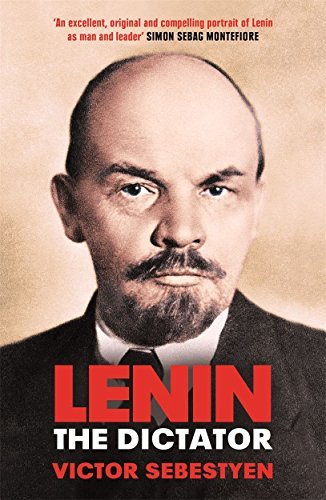
Etter at Nikita Khrusjtsjov i 1956 fordømte Stalins tyranni, ble det et ideologisk behov for å fremstille Lenin som en leder som skapte et godt system som senere ble korrumpert av etterfølgeren. Hadde partiet anerkjent at ondskapen startet med Lenin, ikke Stalins styre ville de revet vekk legitimiteten til partiet. Derfor klamret mange apologeter på venstresiden seg til å overse det meste som var feil med Stalin var planlagt av Lenin.
Journalisten Victor Sebestyen pløyde gjennom 9,5 millioner ord med Lenins samlede verker og trålet flere arkiv for å gi et personlig portrett av grunnleggeren av Sovjetunionen. Denne biografien ble skrevet til 100-årsjubileet for Lenins statskupp i 1917. Den benytter arkiver som ble åpnet på 1990-tallet å vise hvilken innflytelse kvinnene rundt Lenin hadde livet og politikken hans, trekanten Elskerinna Inessa Armand og kona Nadja Krupskaja.
Biografien om lederen gir innsikt i hvordan og hvorfor ytre venstre styrte rett mot diktatur og terror da de først skulle bygge et pariapparat, og deretter tok over verdens største land.
Highlights
Lenin seized power in a coup, but he did not operate entirely through terror. In many ways he was a thoroughly modern political phenomenon – the kind of demagogue familiar to us in Western democracies, as well as in dictatorships. In his quest for power, he promised people anything and everything. He offered simple solutions to complex problems. He lied unashamedly. He identified a scapegoat he could later label ‘enemies of the people’. He justified himself on the basis that winning meant everything: the ends justified the means. Anyone who has lived through recent elections in the supposedly sophisticated political cultures of the West might recognise him. Lenin was the godfather of what commentators a century after his time call ‘post-truth politics’.
— location: 211 ^ref-34280
He was not cruel: unlike Stalin, Mao Zedong or Hitler he never asked about the details of his victims’ deaths, savouring the moment. To him, in any case, the deaths were theoretical, mere numbers. He never donned uniforms or military-style tunics as other dictators favoured. But during his years of feuding with other revolutionaries, and then maintaining his grip on power, he never showed generosity to a defeated opponent or performed a humanitarian act unless it was politically expedient.
— location: 218 ^ref-46928
He built a system based on the idea that political terror against opponents was justified for a greater end. It was perfected by Stalin, but the ideas were Lenin’s.
— location: 222 ^ref-9641
To a biographer, though, the political is the personal, as Lenin would also sometimes say. He was a product of his time and place: a violent, tyrannical and corrupt Russia. The revolutionary state he created was less the socialist Utopia he dreamed of than a mirror-image of the Romanov autocracy.
— location: 234 ^ref-24258
Lenin had excluded the Bolsheviks from joining the government, but for the previous month they had held a small majority on the Petrograd Soviet. Lenin’s plan was to overthrow the government and claim that he was acting on behalf of the Soviets. Real power would lie with him and the Bolsheviks, but keeping the Soviet on board gave him political cover and a semblance of popular support. But there was one big snag. The Congress of Soviets was due to meet that day – in the splendid white and gold ballroom of the Smolny, just below the warren of rooms where the Bolsheviks had been planning the coup. Lenin was supposed to present the takeover as a fait accompli when the Congress convened at noon, and declare a victory for the Revolution.
— location: 408 ^ref-37731
Maxim Gorky, a convinced socialist who was born into deep poverty and really did come from the people, said that ‘Vladimir Ilyich has the self-belief of a “leader”, a Russian nobleman not without some of the psychological traits of that class.’
— location: 676 ^ref-2566
‘Socialism bounced off the peasants like peas against a wall. They listened to our people, as they do to the village priest, respectfully but without the slightest effect on their thinking or their actions.’
— location: 1115 ^ref-26614
Lenin transformed a set of European ideas into a very Russian creation. His version of Marxism – its intolerance, rigidity, violence and cruelty – were forged from Lenin’s experience as a nineteenth-century Russian. Lenin’s Bolshevism had deep Russian roots.
— location: 1143 ^ref-54460
Though he knew nothing about agriculture, he dutifully agreed to try farming, but he didn’t take to it – and nor did he take to the peasants, whom he admitted he never understood.
— location: 1298 ^ref-6445
He was barred from attending a university but was permitted to take the exams as an external student at St Petersburg University, and was allowed to go to the capital to do so. He crammed a four-year course into twelve months and passed top of his year, obtaining the highest marks in all fourteen papers. It was a phenomenal achievement intellectually – and in one of the Russian ironies he would delight in, he got the country’s most brilliant law degree while the organs of the police were keeping him under surveillance as a potential lawbreaking subversive.
— location: 1309 ^ref-7050
Another book that got through the Tsarist censors, who had banned such ‘dangerous’ books as Spinoza’s Ethics, Hobbes’s Leviathan, Voltaire’s Philosophy of History and Locke’s History of European Morals, was Marx’s 674-page tome on political economy, Capital. One of the two censors who looked at it in March 1872 concluded: ‘It is possible to state with certainty that very few people in Russia will read it, and even fewer will understand it.’ The other said that it was ‘a strictly scientific work’ that had no relevance to Russia because it was mostly about the industrial system in Britain, which did not apply to Russia, where there wasn’t ‘capitalist exploitation’. Russian was the first foreign language into which Capital was translated – four years after it appeared in German. It quickly became popular among intellectuals hungry for a cause to believe in.
— location: 1324 ^ref-397
For Ulyanov the end always justified the means – and he kept the end in sight. He was willing to be unpopular.
— location: 1371 ^ref-56404
Ulyanov, though he had lived all his life around the worst-hit famine areas, would have nothing to do with relief or charitable work to help the dying peasants. For him the important thing was that the famine would weaken the autocracy and might further the cause of the Revolution. The thousands of people who died of hunger were simply unfortunate casualties of a war against Tsarist oppression.
— location: 1382 ^ref-39159
Most radical and liberal opinion saw the famine as another example of the miserable failure of a regime whose bureaucracy was too slow and inefficient to save the Russian population from starvation – and too callous to care how many died. Vladimir Ulyanov, though he had lived all his life around the worst-hit famine areas, would have nothing to do with relief or charitable work to help the dying peasants. For him the important thing was that the famine would weaken the autocracy and might further the cause of the Revolution. The thousands of people who died of hunger were simply unfortunate casualties of a war against Tsarist oppression.
— location: 1380 ^ref-11585
He wrote and published more than ten million words in his lifetime, not counting thousands of letters to family, friends and comrades. It is an astonishing output, but he made a halting start. His early articles were spiked for being too boring and dense, even for a theoretical journal of philosophical thought.
— location: 1438 ^ref-27622
At this point in his life, he had made almost no personal contact with the working class in whose name he proposed to lead a revolution. For most of the middle-class Marxists in St Petersburg drawing rooms, the ‘proletariat’ were theoretical.
— location: 1456 ^ref-40314
The Ulyanov style of argument and debate was formed early and did not change significantly over the next two decades. He became better at winning his point, more confident and masterful. But he was nearly always domineering, abusive, combative and often downright vicious. He battered opponents into submission with the deliberate use of violent language which he acknowledged was ‘calculated to evoke hatred, aversion, contempt . . . not to convince, not to correct the mistakes of the opponent but to destroy him, to wipe him and his organisation off the face of the earth’.
— location: 1599 ^ref-49199
Those who disagreed with him were ‘scoundrels’, ‘philistines’, ‘cretins’, ‘filthy scum’, ‘whores’, ‘class traitors’, ‘silly old maids’, ‘windbags’ (one of his favourite epithets, found frequently in his writings) and ‘blockheads’. Often he would resort to the obscene, in language rarely used in the St Petersburg society of that era – his opponents were invariably ‘shits’ or ‘cunts’.
— location: 1616 ^ref-61817
In 1897 there were around 300,000 exiles scattered across Siberia, roughly 5 per cent of its total population.
— location: 2034 ^ref-22378
The first time Vladimir Ulyanov used the name under which he would become famous was in January 1901 in a letter to Georgy Plekhanov. During his life he adopted more than a hundred pseudonyms, some of them just once or twice. It is unclear why Lenin was the name that stuck, but he soon began to favour it, though he used a few others off and on for a short while afterwards. He wrote his first book under the name N. Ilyin and a long list of articles under seemingly random initials or partial names – K. Tulin, Karpov, L. Ul, Petrov, F. Pu, Staryk, K. T. S, Pinyuchev. He had fake passports under several aliases, among them Wilhelm Frei, Jakob Richter, Dr Jordan Jourdanov and Willem Meyer. Originally the adoption of so many pseudonyms was for reasons of security, as a way to confuse the secret police. But the Okhrana was never put off the scent for long, and often the subterfuge caused as many problems to his own comrades as it did to the ‘enemy’.I Hiding identities, creating codes and code-names and maintaining strict security was of course important in any conspiratorial network – and Lenin’s claim to leadership was based as much on his organisational acumen as a plotter as on his ability to inspire as speaker or with his pen. But Lenin was a highly secretive man who enjoyed the cloak-and-dagger element of the revolutionary underground. It became a habit he was unable to break, though he seldom tried very hard. Secrecy was a way of life.
— location: 2069 ^ref-8624
It is true that the penal regime in Tsarist Russia was not as harsh as the Bolshevik system would be, and the Okhrana less bloodthirsty than Lenin’s Cheka. But we are dealing with degrees here, not categories. Thousands of ‘subversives’ died of disease, neglect and starvation in Siberian exile and jail for the ‘crime’ of reading or publishing banned literature, which often included nothing more radical than articles proposing mildly liberal democratic reforms in Russia that were common elsewhere in Europe. Many were executed, without a trial of any kind.
— location: 2221 ^ref-6460
for several years Martov was the closest male friend Lenin had. In their early thirties it seemed as though they had such a strong bond that nothing could divide them. For the last two decades of their lives the bitter enmity between them was one of the main causes of the irreconcilable split within the Russian revolutionary Left.
— location: 2254 ^ref-28072
In Russian law – under the Tsars, later under the Communists and indeed in a modified way in the post-Soviet era – everyone who arrived in a new town or city, even for a few days, was required to register with the police. It was relatively easy for people to assume a variety of false names. It often took time, but invariably the Okhrana would cotton on to what was happening.
— location: 2291 ^ref-49756
The essence of Leninism is contained in his best-known work, What Is To Be Done?, inspired, as the title suggested, by Chernyshevsky. Published in 1902, just before Lenin moved to London, it had a vast impact on the radical movement and made his name as the leader-in-waiting of revolutionary socialism in Russia. It got him noticed throughout Europe as a figure on the Left.
— location: 2650 ^ref-19624
What Is To Be Done? was the bible of Lenin’s Bolsheviks, the blueprint for how he would seize power and hold on to it.
— location: 2656 ^ref-29705
Lenin had no great respect for the working classes for whom he was proposing to make the revolution. ‘The working class exclusively by its own efforts is able to develop only trade union consciousness,’
— location: 2660 ^ref-18634
Nadya, after Lenin’s death, said: ‘The bulk of Lenin’s writing has been done in my presence. In Siberia, before he began to write The Tasks of the Russian Social Democrats, he told me everything that was to be in it. The chapters of The Development of Capitalism in Russia, which he regarded as particularly important, were not written down until he had expounded them to me orally. He worked out the contents of What Is To Be Done? by talking to himself all the time as he walked about the room. After this preliminary work . . . he recited his ideas aloud in order to polish them. Before writing it . . . [he] rehearsed to me every chapter of the pamphlet . . . He liked to do this during our walks. We used to go out of town so that no one would disturb us. He used this same method – preparation first by whispering, then by talking – to write his other works.’
— location: 2696 ^ref-11038
Neither side in this doctrinal dispute would have cared to know what Marx really thought about Russians. As he wrote in a letter to Engels, ‘I do not trust any Russian. As soon as a Russian worms his way in, all hell breaks loose.’
— location: 2745 ^ref-59242
The main issues were arcane, minuscule. Lenin himself admitted that ‘in substance the differences are unimportant’. They were mainly personal – Lenin now identified Martov as a potential rival leader – and only a little about what kind of revolutionary party the RSDLP would be. Lenin wanted a tightly organised, elite corps of dedicated and professional revolutionaries under a highly centralised leadership that imposed discipline on the membership. Martov had in mind a looser, more inclusive party, less under the control of the leadership, where members had significantly more of a voice.
— location: 2828 ^ref-55487
At a time when Russia needed wise and imaginative leadership, it was landed with a ruler totally unequipped for the role. It is no exaggeration to say that every major decision Nicholas II took was wrong – from his choice of wife, Alexandra, who compounded his own misjudgements, to his disastrous decisions on war and peace.
— location: 3022 ^ref-61942
At no point in his life did he have any direct experience of fighting, yet that did not stop him from writing in bloodcurdling fashion as though he were a military expert.
— location: 3140 ^ref-43632
Nicholas encouraged extremist nationalist groups to support him against democrats, liberals and socialists. He was an enthusiastic backer of the newly formed Union of the Russian People, which rallied to the support of ‘Tsar, Faith and Fatherland’. He invited its leaders to his palace at Tsarskoe Selo, wore its insignia on his uniforms and subsidised its newspapers. By 1906 it had 300,000 members, nearly a hundred times more than Lenin’s Bolsheviks.
— location: 3329 ^ref-58521
As usual, where the violence was, Lenin wasn’t. Once again his personal bravery was put in question. In his circle of confidants and the Party leadership it was axiomatic that he was too important to the Revolution to take risks with his safety.
— location: 3356 ^ref-31451
When someone in the crowd, spotting some cavalry, shouted “Cossacks!” Lenin was the first to run.
— location: 3367 ^ref-4863
Lenin didn’t believe in individual murders and targeting particular officials of the regime for assassination; he argued they were pointless forms of ‘single combat’. He didn’t argue on principle but on practical results: ‘Do they help attain our desired ends – or on the contrary divert from them?’
— location: 3376 ^ref-17744
The Party couldn’t rely entirely on donations from millionaire magnates – Russian oligarchs of a bygone age – to finance the Revolution. Money had to be found in other ways and Lenin built what was in effect a criminal gang to steal on the Party’s behalf, perhaps an original model of the Russian mafia. He didn’t directly order any of the raids himself and he called them, in an echo of Marx, ‘expropriations’, but whatever the euphemism he chose, this was banditry.
— location: 3402 ^ref-59817
Making revolution was an expensive business and while in exile Lenin always needed money. He controlled the Bolsheviks’ finances personally and, secretive as ever, he told nobody exactly how it was spent, not even Nadya. He pored over accounts with immense care and itemised all expenditure in obsessive detail down to the last kopeck.
— location: 3532 ^ref-13536
later. Lenin spent hours simply looking out over the water towards a distant lighthouse, doing nothing. ‘He kept dropping off to sleep all the time. When he got to the woods he would sit down under a fir tree and fall asleep at once. The children from the neighbouring cottage called him “sleepy head”.’ He told his mother and sister Maria: ‘The rest I am getting is marvellous, the best I have had in years. No people, nothing to do. No people and nothing to do is the best thing for me.’ Soon, however, he was on the road again, as the Bolshevik representative at the Congress of the Socialist International – an organisation originally founded by Marx – held in Stuttgart at the beginning of August. One of Lenin’s great skills, as Martov noted, was ‘packing Congresses’ – lobbying for votes, collecting together a caucus, elaborately planning how a debate was to be conducted, making behind-the-scenes deals. Martov, contemptuous of these political realities, meant his comment as a criticism and he used the phrase derisively. But it showed why Lenin succeeded and Martov and the Mensheviks failed.
— location: 3557 ^ref-38556
One of Lenin’s great skills, as Martov noted, was ‘packing Congresses’ – lobbying for votes, collecting together a caucus, elaborately planning how a debate was to be conducted, making behind-the-scenes deals. Martov, contemptuous of these political realities, meant his comment as a criticism and he used the phrase derisively. But it showed why Lenin succeeded and Martov and the Mensheviks failed. Lenin didn’t only use vulgar invective or bully opponents into submission by insults. He could glad-hand other delegates, take an interest in their lives and, when he needed to, could listen: ‘he could inspire followers with the personal touch’.
— location: 3562 ^ref-46697
Lenin frequently quoted a line from Gogol’s The Government Inspector to justify the employment of crooks, rogues, killers and ruthless rascals: ‘A good household makes use even of the garbage.’
— location: 3645 ^ref-26619
Stolypin’s clampdown against opposition had nearly destroyed the revolutionary groups within Russia. At the high point of the 1905 uprising there was a combined membership of an estimated 140,000 – of either the Socialist Revolutionaries, the biggest single group, or the two wings of the Social Democrats; now in 1908 there were less than 7,000.
— location: 3680 ^ref-64799
On the edge of the village he spotted an abandoned workshop and some outhouses, which he realised would be the perfect home for a project he had been planning for some time: he wanted to open a school for working-class Party members from inside Russia, whom he could train in the theory of Marxism and the practice of conspiracy.
— location: 4006 ^ref-57637
Nadya was patient and determined to make the best of it. She may have been jealous, but she saw her main task as Lenin’s helpmate, ensuring his peace of mind. If that meant giving Inessa warmth and friendship, it probably seemed like another sacrifice she was prepared to make for the Revolution.
— location: 4055 ^ref-1611
Making deals with ‘bourgeois democrats’ and ‘soft liberals’ was a treacherous road for revolutionaries, he argued. Then in May 1912 he changed his mind, put up Bolsheviks for seats in the forthcoming Fourth Duma elections and wrote several articles in favour of parliaments in general and Nicholas II’s Duma system in particular.
— location: 4103 ^ref-37775
Elena Stasova, Lenin’s most senior agent in St Petersburg, wrote around this time telling him that the Party had been ‘almost destroyed’ and there were probably no more than 800 loyal Bolsheviks in the capital, and perhaps the same number again in all of Russia.
— location: 4116 ^ref-32161
He became central to the regime’s main policy in dealing with the Social Democrats: keeping the party divided and fighting among themselves. Part of the strategy was to build up Lenin, who was still vehemently against healing the Party split with the Mensheviks.
— location: 4138 ^ref-39599
it was one of the most professionally produced. Despite regular harassment from the regime it survived a range of crises. It was banned nine times – only to reappear the next day, with a slightly different title. The new name would always have the word ‘Pravda’ in it. So when the regime closed one paper down, a new incarnation would appear – Workers’ Truth, Daily Truth, Evening Truth, Truth of Labour, The Way of Truth, Proletarian Truth, and so on. The job of editor was not the safest, though the paper was supposed to be legal. In its first thirty-eight issues Pravda had a succession of thirty-six editors, all of whom were arrested. Between them they spent forty-seven months in jail. By the time the regime finally banned it soon after the First World War began, 636 issues of Pravda had appeared and Lenin had written voluminously for the paper – 280 pieces under his byline, many more unsigned.
— location: 4193 ^ref-7653
Lenin had such self-belief that he rarely thought anybody could perform better than him at anything that required political judgement and skill.
— location: 4345 ^ref-989
By the end of October 1914 Russia had lost 1.2 million men, killed, wounded or missing, a high proportion of whom were trained junior officers and professional NCOs.
— location: 4524 ^ref-65325
Two years before the war began a St Petersburg publisher, Mikhail Kedrov, brought out three volumes of his collected works. There were only 200 subscriptions. He had produced a print run of 3,000 but fewer than half were sold within a year and the rest were remaindered as waste paper.
— location: 4585 ^ref-16111
Lenin’s line was simple. He wanted his country to lose the war; defeat would be a spark to revolution. ‘Tsarism is a hundred times worse than Kaiserism,’ he told Alexander Shlyapnikov, one of the leading Bolsheviks in Scandinavia, who ensured that the statement was smuggled from Sweden into Russia.
— location: 4648 ^ref-9060
The Left, including the Social Democrats, split into three groups with different positions on the war. The Defencists supported their own countries ‘in defence of the Fatherland’. The Internationalists were neutral and maintained what had been the traditional socialist argument that workers shouldn’t be killing each other for the benefit of the capitalists. The Defeatists wanted their own country beaten as the lesser of two evils because ‘victory’ would strengthen their own capitalist regimes and delay the Revolution. Lenin was the arch-‘defeatist’, but would also support the Internationalists when compromise with them made tactical sense.
— location: 4660 ^ref-12905
Alexander Blok chased women frenetically, and his actress wife Lyuba was only slightly less promiscuous. ‘I have had a hundred women – 200 – 300 (maybe more?),’ he wrote. ‘But really only two: one is Lyuba; the other – all the rest.’
— location: 4929 ^ref-45215
He knew, if Nicholas didn’t, that the troops wouldn’t obey orders. The Revolution was sparked by bread riots but it succeeded because every regiment in the Petrograd guard – the smart regiments that for centuries had been fiercely loyal to the Romanovs – mutinied.
— location: 5053 ^ref-29725
Historians have often said that it had been a generally peaceful uprising. This is a popular myth that has gained authority largely because the February Revolution was genuinely supported by the vast majority of people. But it was violent. Far more people were killed in February than would die in the Bolshevik coup in October – 1,433 in Petrograd and around 3,000 in Moscow, where armed gangs roamed the streets for several days. The October coup was almost bloodless by comparison.
— location: 5065 ^ref-53439
Historians have often said that it had been a generally peaceful uprising. This is a popular myth that has gained authority largely because the February Revolution was genuinely supported by the vast majority of people. But it was violent. Far more people were killed in February than would die in the Bolshevik coup in October – 1,433 in Petrograd and around 3,000 in Moscow, where armed gangs roamed the streets for several days. The October coup was almost bloodless by comparison
— location: 5065 ^ref-4497
The highest-ranking Bolshevik in Petrograd at the time, Shlyapnikov, who reached Petrograd soon after the Revolution, admitted later that in February 1917 the Bolsheviks were weak, with a maximum of 3,000 members in Russia, and almost entirely broke.
— location: 5098 ^ref-40676
‘The Germans turned upon Russia the most grisly of all weapons. They transported Lenin in a sealed train like a plague bacillus from Switzerland into Russia.’ Winston Churchill, The World Crisis, Volume Two, 1929
— location: 5145 ^ref-51054
General Erich Ludendorff, as Quartermaster-General one of the two most senior commanders in the German army, admitted that he had no idea who Lenin was before the February Revolution in Petrograd – and didn’t have any understanding of Lenin’s politics or of Marxism. It was mumbo jumbo to him. But if Lenin could help to destabilise Russia, wooing him onto their side made military sense.
— location: 5174 ^ref-41141
He was making revisions to a pamphlet that he had begun writing and nearly completed, which would become known as The April Theses – one of the most dramatic of his ‘deviations’ from Marxist orthodoxy, which became required reading in Soviet schools after Lenin’s death. In little more than 10,000 words Lenin completely overturned Marx’s teaching that every society must go through a ‘bourgeois’ capitalist period as a first stage before there could be a socialist revolution. He declared that backward, mainly agrarian peasant Russia could leap through the industrial, capitalist phase of development and spark a socialist revolution that all of Europe would soon copy. And he outlined more or less exactly how the Bolsheviks would seize power in Russia and institute a ‘dictatorship of the proletariat’.
— location: 5286 ^ref-27056
Next, he was irritated by the fug of tobacco smoke that had quickly filled almost the whole of the carriage. Lenin instituted a smoking ban on the train and would permit it only in the two lavatories. Predictably a long queue formed, and there were noisy, acrimonious quarrels between the passengers – most revolutionary Russians of that era tended to be chain-smokers. Lenin improvised a socially just answer: he got some paper and carefully cut it into strips for use as ‘tickets’, one set for smoking, the other for normal lavatory use. Lenin, naturally, was the ticket-master. This was the earliest known example of a Lenin-inspired, Communist-run rationing system: imposed from above, no objections permitted, causing maximum sullen dissatisfaction to many.
— location: 5304 ^ref-60896
Accompanied by Radek to the most upmarket department store in Stockholm, Bergström’s, he bought a smart new suit and some decent black shoes. ‘Most likely it was the decent appearance of our stolid Swedish comrades that was evoking in us a passionate desire for Ilyich to resemble a human being,’ said Radek. Lenin also bought a bowler hat, and an entirely new item he had never worn before – a dark-grey workman’s peaked cap. It would soon become his trademark headwear.
— location: 5343 ^ref-33309
In later years citizens in Communist states became used to big orchestrated ceremonies and mass rallies on the high days and holidays of socialist rule – May Day, for example, and the anniversary of the October Revolution. They were a major part of the Soviet way of life. Even when some Communist regimes proved to be useless at organising virtually everything else, they could always mount a good parade.
— location: 5436 ^ref-61109
Overnight the Revolution had brought political freedoms never before known in Russia – and hardly ever since. People could say, write and read what they wanted, something they could not do a year later – nor their great-grandchildren a hundred years later. Within days, scores of newspapers representing all shades of opinion began appearing on the streets of Petrograd, Moscow and other cities. But along with those freedoms came anarchy, violence and a breakdown in law and order which the government was unable to prevent.
— location: 5546 ^ref-14381
The Soviets were hastily elected representatives from factories, army regiments and land communes, chosen within days of the Revolution, usually without a secret ballot. The Petrograd Soviet was more than 600-strong. They were not representative or in any modern sense democratic. But nor was the Duma which appointed the coalition government; that was a gerrymandered so-called parliament rigged by the Tsar and based on a minuscule electorate of property owners.
— location: 5580 ^ref-57859
The Duma was equally a madhouse: ‘members were motivated by one single characteristic: their fear of the masses – and who could blame them’. In particular they were scared of the soldiers, whose mutiny had brought down the Tsar, and whose anger could turn on them. Three
— location: 5600 ^ref-46990
The public Lenin adopted a highly populist style of politics that would be recognisable – and imitated by many a rabble-rouser – a hundred years later, even in long-established, sophisticated democracies. He offered simple solutions to complex problems. He lied unashamedly. He was never a sparkling orator, as Kerensky and Trotsky were in their varying ways. But he was brilliant at presenting a case in direct, straightforward language that anyone could understand, and explaining how the world could be changed if only people would listen to him and his Bolsheviks. Economic injustice and semi-feudalism had held Russia back for centuries? His answer was simple: ‘All the people have to do is expropriate a thousand banking and industrial big-shots . . . and break the resistance of a few dozen millionaires,’ he said. The people were hungry for land? Simple. ‘The peasants must seize the estates from their former landowner masters. They must be masters now.’ Workers may not understand how to run industries?
— location: 5685 ^ref-10348
Lenin attacked it for ‘betraying’ democracy. Of course, he didn’t believe in ‘bourgeois democracy’ – free elections between competing political parties, and there would be none for seventy years in the state which he created.
— location: 5702 ^ref-57544
The Allied interference led directly to a military disaster which hastened the second 1917 Revolution and helped bring about the outcome they least wanted: Bolsheviks in power and Russia’s withdrawal from the war.
— location: 5988 ^ref-32919
‘When there’s the State there’s no freedom; when there’s freedom there will be no State.’ Lenin, The State and Revolution, 1917
— location: 6197 ^ref-54989
The next few weeks showed Lenin’s great skills as a leader. If anything disproves the Marxist idea that it is not individuals who make history but broad social and economic forces it is Lenin’s revolution.
— location: 6347 ^ref-63814
Lenin knew that power could slip away at any time, which explains so much of the seventy-four-year history of the Soviet State. From 25 October 1917, having achieved power illegitimately, Lenin’s only real concern for the rest of his life was keeping it – an obsession he passed down to his successors. Throughout its existence the Soviet Union identified itself with the founder of the State, alive or dead. The regime he created was largely shaped by his personality: secretive, suspicious, intolerant, ascetic, intemperate.
— location: 6503 ^ref-43078
On 27 October Lenin wrote a Decree on the Press which established a system of censorship run by his Party apparatchiks. ‘Any organ of the press may be . . . [closed down] for inciting resistance to the Decrees of Sovnarkom . . . or if found to be sowing confusion by means of obviously defamatory distortion of the facts.’
— location: 6556 ^ref-16761
Lenin’s tactics were to string out the talks for as long as possible – and he knew just the man who could obfuscate for ages. At first Joffe led the Russian delegation. After a few days he was replaced by Trotsky. Nobody could make longer speeches going nowhere than Trotsky. Lenin told him before departing to Brest: ‘We need someone to do the delaying . . . and you will do it better than anybody. String out the talks until there is a revolution in Germany – or as long as possible.’
— location: 7031 ^ref-45445
One of Lenin’s decrees codified Bolshevik ideas of ‘revolutionary justice’. At a stroke he abolished the existing legal system, though he kept the Tsarist principle that there was one system of justice for normal crimes against property and separate laws for crimes against the State. He established ‘People’s Courts’ for common criminals – essentially ad hoc mob trials in which twelve ‘elected’ judges, most of them barely literate, would rule less on the facts of a case than with the use, in Lenin’s words, of ‘revolutionary conscience’. Lenin’s hatred of the law and lawyers shone through in this decree. ‘The Court proceedings were not evidence-based, the procedures were more or less made up as they went along.
— location: 7262 ^ref-61138
On 21 February 1918 Lenin issued a decree, ‘The Socialist Fatherland in Danger’ – written in his familiar literary style – which allowed Red Guards to ‘shoot on the spot . . . enemy agents, profiteers, marauders, hooligans and counter-revolutionary agitators’.
— location: 7285 ^ref-19820
Requisition brigades, as they were called, were sent to more than 20,000 villages within the first two months of the decree. Usually they consisted of seventy-five men, armed with two or three machine guns, who would surround a village and demand that peasants hand over a set yield of grain decided by the local Bolshevik Party headquarters. ‘Speculators who are caught red-handed not delivering the required amount of grain and can be convicted on clear evidence will be executed on the spot,’ Lenin’s decree declared.
— location: 7411 ^ref-16868
On 23 August he wrote to the Bolshevik chiefs in Penza Province: ‘Comrades, the kulak uprising in your five districts must be crushed without pity. The interests of the whole Revolution demand it, for the final and decisive battle with the kulaks everywhere is now engaged. An example must be made. 1) Hang (and I mean hang, so the people can see) not less than 100 known kulaks, rich men, bloodsuckers. 2) Publish their names. 3) Identify hostages . . . Do this so that for hundreds of miles around the people can see, tremble, know and cry: they are killing and will go on killing the bloodsucking kulaks. Cable that you have received this and carried out [instructions]. Lenin. PS Find tougher people.’
— location: 7425 ^ref-50603
Even by the government’s official figures the food brigades collected only about 570,000 tons – from a total harvest yield of forty-nine million tons. Lenin later wound down the food brigades and, for a while, his rhetoric against the peasants softened. He tried a different tactic to get them on his side. But campaigns against kulaks and forcing farmers at gunpoint to produce for the State became a feature of Soviet life for decades to come.
— location: 7448 ^ref-2753
‘In England and France they executed their kings some centuries ago, but we were late with ours.’ Lenin, 1919
— location: 7524 ^ref-2348
Altogether 6,185 death sentences were issued in the two months after Lenin was shot, but it is likely that many more people were killed. ‘We must put an end once and for all to the papist-Quaker babble about the sanctity of human life,’ Trotsky said, justifying the terror.
— location: 7821 ^ref-52812
The workers might have understood, had the privileges remained at a few decent meals. But the system quickly extended into a range of perks for the Communist elite based on seniority, length of membership, and loyalty. It was a system that had nothing to do with Marxism, but mirrored the complex chin system of the Tsarist civil service, with its minutely graded table of ranks which awarded benefits in a highly rigid manner. The Communist Nomenklatura system likewise protected the best jobs for Party members. Within two years, 4,000 Bolsheviks and their families were living in the Kremlin and the hotels commandeered by the Party, the Metropol and the National, both by Red Square.
— location: 7933 ^ref-11417
He coined a new word for the careerist breed of new Communists, which Trotsky would steal and later use often: ‘radishes – Red on the outside, White inside’.
— location: 7961 ^ref-20764
Censorship was established immediately after the Revolution but was mild for the first three years. The State Publishing House, Gosizdat, was founded by Lenin in December 1918 and took a monopoly on book publishing. The following year it had a monopoly on paper production; three years later, on the sale of all books. All manuscripts had to go to a preliminary censor, as they had done in Tsarist times. For the first few years, before Lenin became ill, censorship operated with a light hand. But within a few years some of Russia’s best writers had left: Ivan Bunin, Marina Tsvetaeva, Alexei Tolstoy, Boris Zaytsev, Vyacheslav Ivanov. Eventually Gorky left.X When Evgeny Zamyatin, author of the brilliant dystopian novel We, emigrated he said: ‘Russian literature will only have one future – its past.’
— location: 8134 ^ref-50606
about strategy and tactics. There were all kinds of practical and military reasons the Whites lost the war: they controlled a smaller population to recruit from, and their problems with communications were insuperable. But the main reason ran deeper. The Whites were stuck in the past – they were ‘the last dream of the old world’, as the poet Marina Tsvetaeva, one of their passionate devotees, put it. Most
— location: 8190 ^ref-41260
Above all, Lenin was lucky in his enemy. In contrast to the Bolsheviks’ unified leadership, the ‘Whites’ were fragmented; there were three main armies separated by thousands of miles. Even when they managed to communicate over such vast distances, their leaders often loathed each other and had strong disagreements about strategy and tactics. There were all kinds of practical and military reasons the Whites lost the war: they controlled a smaller population to recruit from, and their problems with communications were insuperable. But the main reason ran deeper. The Whites were stuck in the past – they were ‘the last dream of the old world’,
— location: 8187 ^ref-52428
Most Russians – and the minority groups in the empire, from Finland to the Caucasus – may have loathed and feared the Bolsheviks, but they did not want a return to the past. ‘We didn’t put forward a single new idea,’ acknowledged Vasily Shulgin, one of their leaders, in the summer of 1919.
— location: 8193 ^ref-49493
It was a devastating blow for the Whites, whose defeat was accompanied by a mass migration from Russia. Between 1.5 and two million people left the country within two years of the Revolution, most of them educated, professional people, the intelligentsia.
— location: 8418 ^ref-61677
But he took the establishment of the Comintern (Communist International) seriously. This was to be the group of socialist parties throughout Western Europe and the US that would spark the revolutions – as the Bolsheviks had done in Russia. The idea was based on his version of a Marxist principle: ‘The interests of socialism, of world socialism, are superior to national interests, the interests of the State.’ But, as so often, Lenin’s need to control organisations, centralise them and dominate them turned the principle on its head. The Comintern was run from Moscow and soon became a branch of Soviet foreign policy.
— location: 8593 ^ref-58923
Lenin gave the subsidies from the Soviet regime to dozens of Communist Parties abroad which were to continue under his successors well into the 1980s.
— location: 8657 ^ref-50542
On 28 February 1921 a mass meeting of sailors on two battleships, the Petropavlovsk and the Sevastopol, drew up a resolution demanding free elections to a new parliament, free trade unions independent of the Communist Party, a free press, the abolition of the Cheka – and a range of other broadly democratic reforms. The next day there was a demonstration of 16,000 sailors in the centre of the Kronstadt barracks town, where the demands were read out again by the young man who became the sailors’ leader, a twenty-one-year-old petty officer on the Sevastopol, Stepan Petrichenko. A small group of ratings seized the printing plant, peacefully, and started publishing a newspaper, the Kronstadt Izvestia. At no stage did they threaten violence or move in any way against Petrograd, which they could have shelled from their gun batteries or blockaded if they had chosen to. They had planned no uprising; theirs was a spontaneous expression of disappointment and anger. Immediately Lenin saw them as a threat and demanded they climb down ‘or face destruction’. The sailors continued to publish their paper and Lenin put Trotsky in charge of smashing them.
— location: 8703 ^ref-14425
Lenin would always justify the terror on principle, but occasionally relented when he was made aware of individual cases.
— location: 8736 ^ref-18758
But these cases were like appeals to the sovereign in imperial times. Justice was arbitrary. For the millions who had no access to Gorky or to the Kremlin there was no protection against corrupt, vicious and cowardly officials, or the Cheka. Lenin’s Russia was a state effectively without law.
— location: 8760 ^ref-26108
Hoover’s aid workers fed twenty-five million people in the Volga region alone and saved hundreds of thousands of lives before the ARA closed down its Russian efforts – prematurely. When it was revealed that the Soviets were taking foreign aid but at the same time selling its cereals for hard currency, it caused a scandal that forced the ARA teams to leave Russia, amid bitterness.
— location: 8802 ^ref-33532
He had said many times that a revolutionary’s health was a Party concern and ‘public property’.5 One
— location: 9187 ^ref-45257
The final row between Lenin and Stalin was personal, not political. Lenin did not suddenly discover, as he was dying, Stalin’s true nature. He knew all along, and had not been too bothered by ‘the wonderful’ Georgian’s ruthless immorality. Lenin created the monster, and it was his greatest crime that he was now leaving Stalin with good prospects of becoming the Soviet dictator.
— location: 9224 ^ref-62263
Lenin created the monster, and it was his greatest crime that he was now leaving Stalin with good prospects of becoming the Soviet dictator.
— location: 9226 ^ref-22742
‘For Russians, their worst misfortune was Lenin’s birth; their next worst, his death.’ Winston Churchill, The World Crisis, Volume Two, 1929
— location: 9387 ^ref-14897
The best accounts of the October Revolution remain the eyewitness reporting of Nikolai Sukhanov, The Russian Revolution 1917: A Personal Record, London, 1955
— location: 9632 ^ref-39044