Poster for Social Science History Association
During the summer of 2006 I attended the great ICPSR Summer Program in Quantitative Methods at the University of Michigan, Ann Arbor. Together with two brilliant researchers from Illinois and Minnesota, we prepared a research poster using the statistical techniques studied at the program. The poster we made was accepted at the annual The Social Science History Association conference, which is one of the most important in this research field.
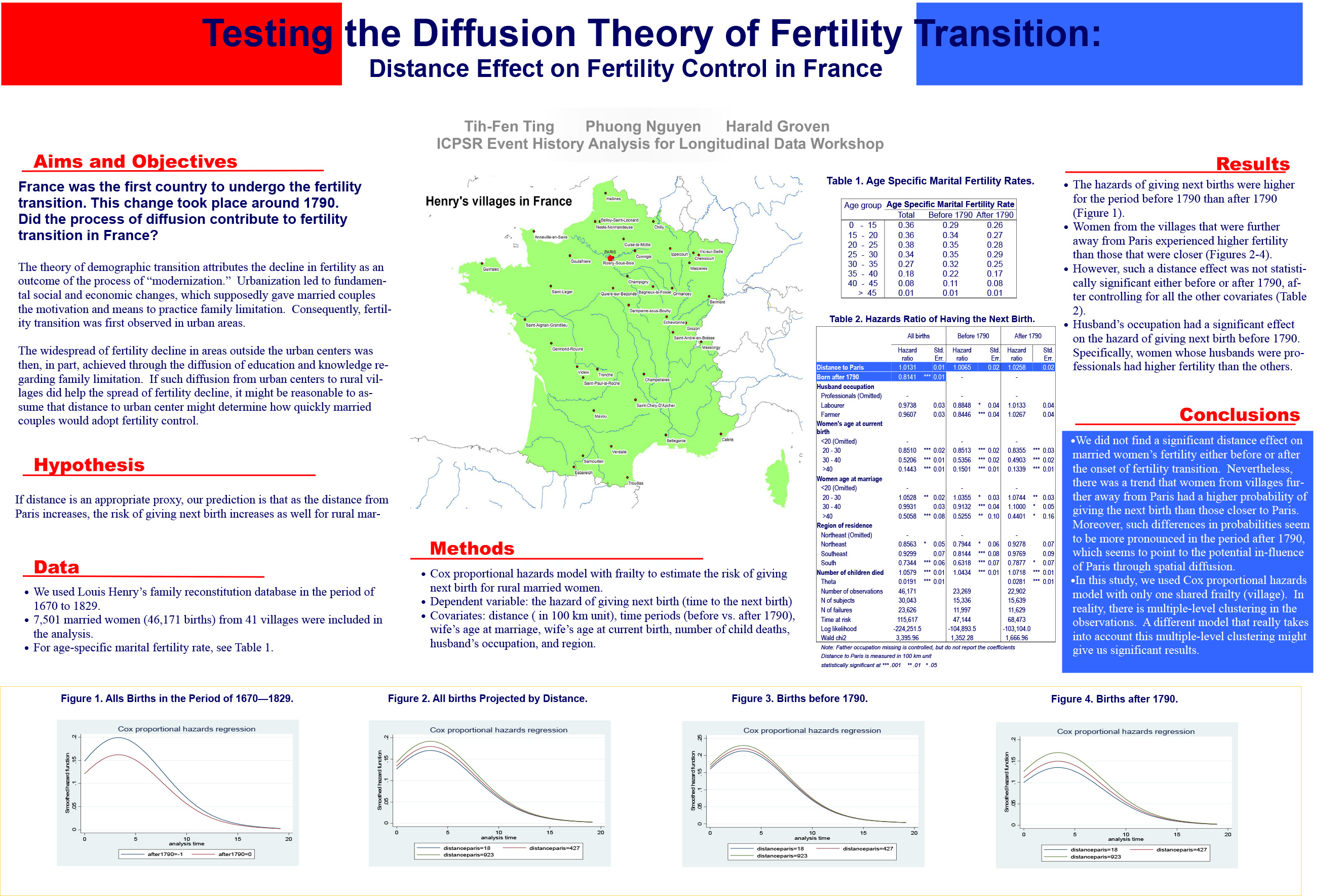
Testing the Diffusion Theory of Fertility Transition: Distance Effect on Fertility Control in France, 1780-1800
Abstract
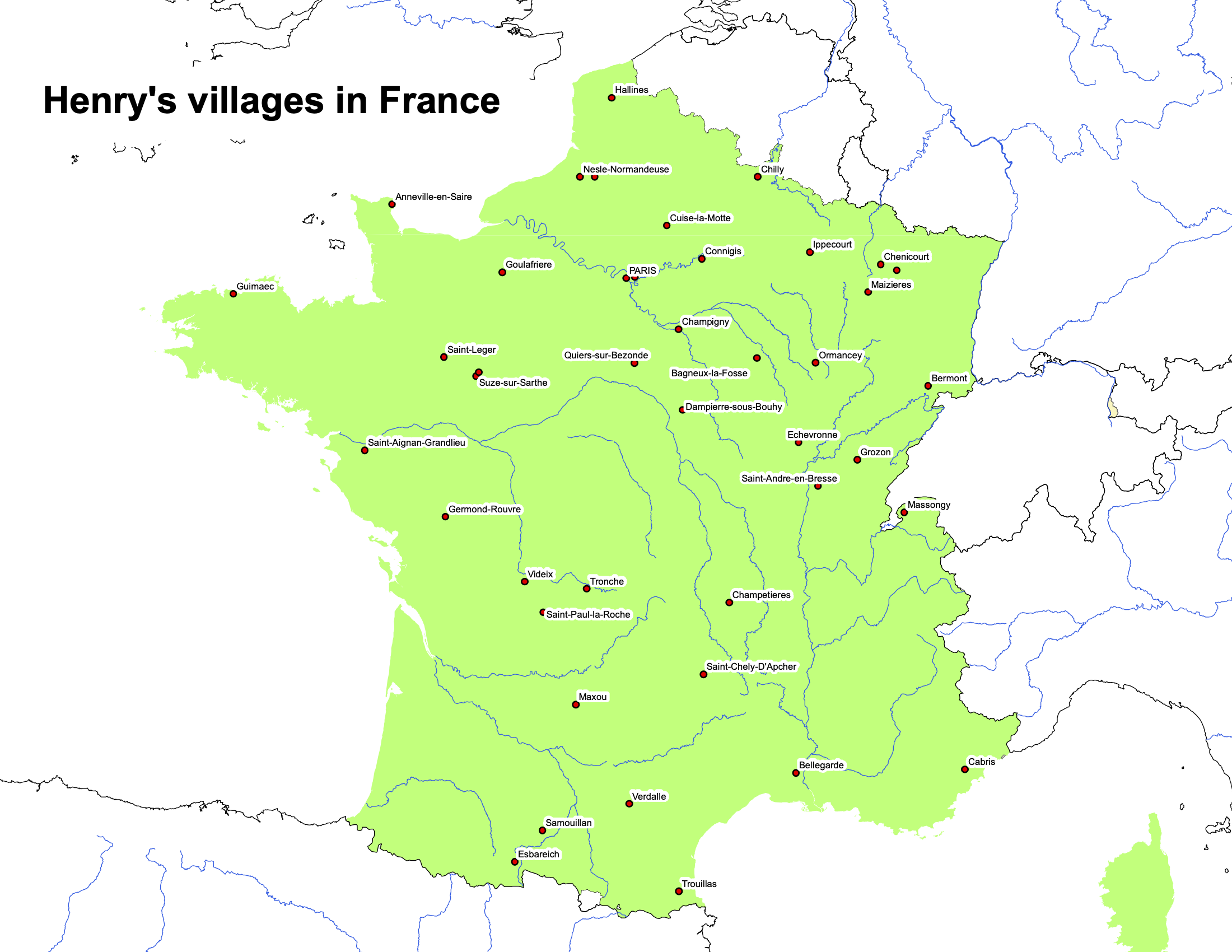
The theory of demographic transition attributes the decline in fertility as an outcome of the process of “modernization”. Mainly, beginning in late 18th century, increasing urbanization led to fundamental social and economic changes, which supposedly gave married couples the motivation and means to practice family limitation (See Knodel and van de Walle 1979, Alter 1992). Consequently, fertility transition was first observed in urban areas. The widespread of fertility decline in areas outside the urban centers was then, in part, achieved through the diffusion of education and knowledge regarding family limitation. If such diffusion from urban centers to rural villages did help the spread of fertility decline, it might be reasonable to assume that distance to urban center might determine how quickly married couples would adopt fertility control. To our knowledge, no study has explicitly examined such a distance effect. Being the political, cultural, and urban center of France, Paris was at the forefront of fertility transition. We would like to use the Henry Data to test whether an increase in distance from Paris contributes to an increase in the hazard (probability) of giving next birth by married women from rural French villages before and after 1790. In other words, our prediction is that as the distance from Paris increases, the risk of giving next birth increases as well for rural married women, after controlling for the occupational status of the rural couples.
Data Source
Data Source: Henry Data.
Independent variables/Covariates:
- Distance between Paris and each individual village in the Henry Data Set (as the proxy to the influence by Paris)
- Occupation of the couple
- Time periods (before vs. after 1790)
Dependent variable: the hazard of giving next birth
References:
- Alter, G. 1992. “Theories of Fertility Decline: A Non-specialist’s Guide to the Current Debate on European Fertility Decline,” in The European Experience of Declining Fertility, 1850-1970, edited by John Gillis Louise Tilly, and David Levine, pp. 13-27. Cambridge, MA: Blackwell.
- Knodel, J., & Van de Walle, E. (1979). Lessons from the past: Policy implications of historical fertility studies. In A. J. Coale, & S. C. Watkins (Eds.), The decline of fertility in Europe (pp. 390-419). Princeton, NJ: Princeton University Press.